
From Regulatory Reporting to Regulatory Confidence
Executive Summary
Regulatory reporting is entering a new phase of maturity. Complete, accurate and timely submissions remain essential, but supervisors increasingly expect institutions to demonstrate confidence in the governance, controls, interpretations, reconciliations and decisions behind every reported value.
That expectation changes the scope of the challenge. Trusted reporting is no longer the responsibility of a reporting team alone. It depends on capabilities distributed across Finance, Risk, Compliance, Operations, Technology, Data Management and the business - long before a return is assembled.
Katalysys calls the resulting enterprise capability Regulatory Confidence: the ability to demonstrate that regulatory information is complete, traceable, well governed and supported by sustainable operating disciplines. Confidence is not created at filing. It is built continuously through the operating model that supports every submission.
“Regulatory Confidence is the organizational capability to explain, substantiate and govern the information supporting every regulatory submission.”
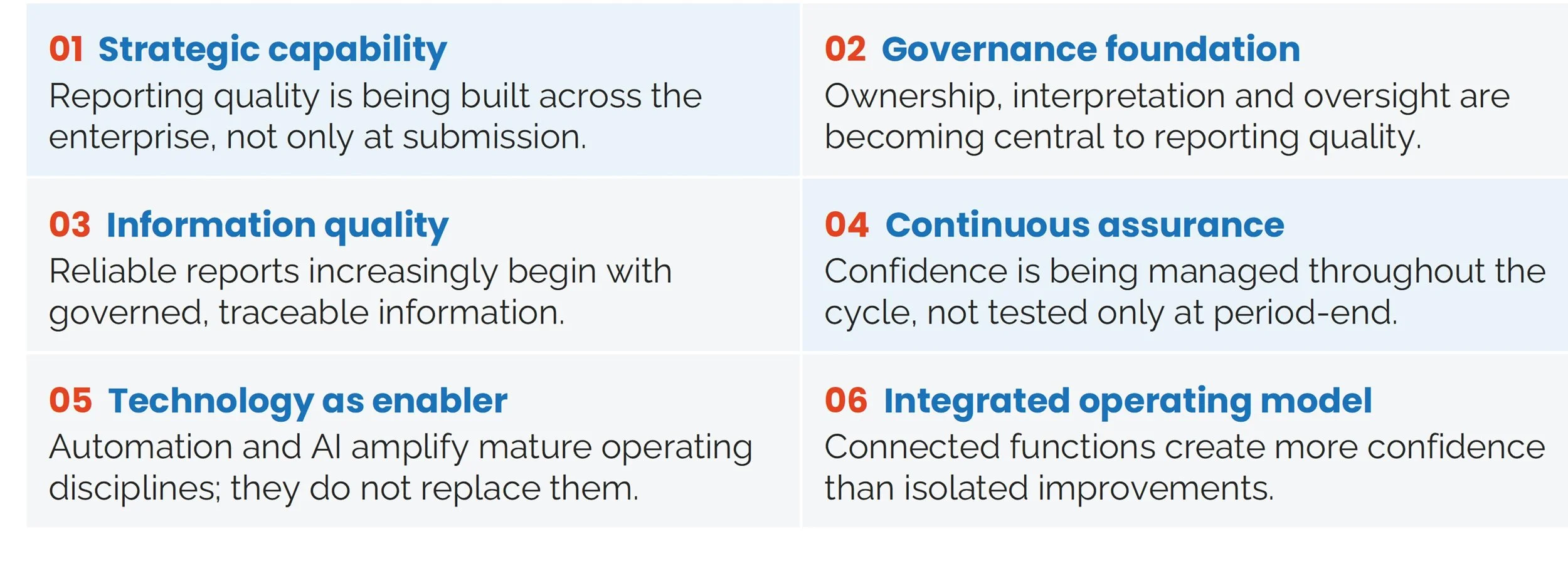
Six forces are reshaping regulatory reporting
Why regulatory reporting is entering a new era
The report is only the visible endpoint.
For many years, regulatory reporting was judged mainly by operational outcomes: was the return complete, accurate and submitted on time? Those tests remain fundamental. The supervisory lens, however, now reaches well beyond the completed report.
Institutions are increasingly expected to explain how reported information was derived, why interpretations were applied, which controls validated the result, how material assumptions were approved and how management gained confidence before submission. A reporting issue can therefore expose weaknesses in governance, data, accountability or operating design - not just an error in production.
Viewed in this context, regulatory reporting is the disciplined transformation of enterprise information into information that regulators, executives and Boards can rely on. It connects regulatory requirements to business interpretation, ownership, data, controls, reporting and continuous monitoring.
The supervisory lens is widening
EMERGING LENS
Traceable information and lineage
Documented interpretation and ownership
Continuous controls and monitoring
Evidence-based executive confidence
TRADITIONAL LENS
Report completeness
Accuracy at submission
Timeliness
Period-end review
EXECUTIVE IMPLICATION
Regulatory reporting becomes a strategic capability when leadership can see and govern the enterprise disciplines that make every submission trustworthy
The Katalysys regulatory confidence framework
Confidence is built across the reporting lifecycle
Regulatory Confidence is not the result of a single control or technology platform. It emerges when connected disciplines convert regulatory requirements into governed, traceable and continuously monitored reporting outcomes.
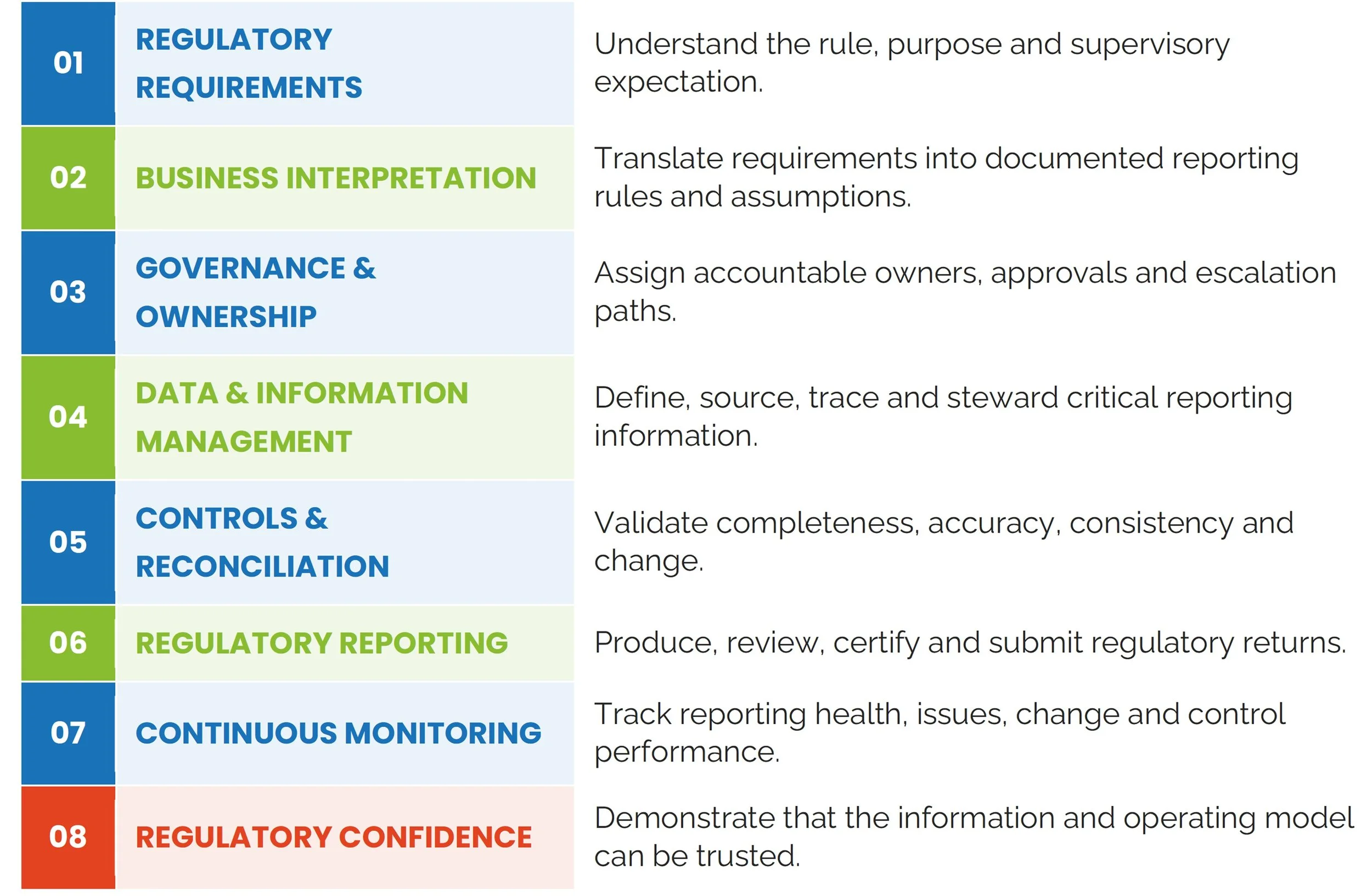
Each institution will implement these disciplines differently, but the direction of travel is consistent: trusted reporting is moving upstream, becoming more integrated and being managed continuously.
The six forces reshaping regulatory reporting, and how the Katalysys Regulatory Confidence Framework helps institutions address them, are outlined below.
FORCE 1 Regulatory Reporting Is Becoming a Strategic Business Capability
What’s Changing?
Regulatory reporting was traditionally treated as the final stage of a recurring production cycle. Business functions generated information, technology processed data, reporting teams assembled returns and success was judged at submission.
That view is giving way to a broader one. Reporting quality is shaped much earlier by business process design, regulatory interpretation, information management, governance, technology, risk management and executive oversight.
Leading institutions are therefore strengthening the enterprise capability that connects people, processes, information, controls and technology - not only the mechanics of filing.
Why It Matters
A production-only lens directs investment toward automation and workflow efficiency. Those capabilities matter, but they address only one part of the lifecycle.
Upstream investment in ownership, interpretation, data quality, reconciliations and governance improves reporting while also strengthening operational resilience and executive decision-making.
QUESTIONS BANKING LEADERS SHOULD CONSIDER
Is reporting treated as a function or an enterprise capability?
Do Finance, Risk, Compliance, Technology and the business share accountability for quality?
Are investments strengthening report production or the conditions that make reports trustworthy?
Can management assess confidence before a report is submitted?
KATALYSYS INSIGHT
Institutions differentiate themselves not by how efficiently they produce reports, but by how effectively they build the capabilities that make those reports trustworthy.
FORCE 2 Governance Is Becoming the Foundation of Regulatory Reporting
What’s Changing?
Reporting governance once focused mainly on deadlines, approvals, submissions and issue coordination. That role is expanding across the full lifecycle.
Clear ownership of reported information, documented interpretations, oversight of material assumptions, evidence of management review and transparent escalation are becoming essential components of reporting quality.
Reliable reporting is increasingly understood as the outcome of effective governance, not simply an efficient reporting process.
Why It Matters
Governance reduces uncertainty. Defined ownership improves consistency; documented interpretations make decisions repeatable; and timely oversight gives management visibility before emerging risks become regulatory issues.
It also enables an institution to explain - not merely defend - what it reports by showing the policies, evidence, approvals and decisions behind material values.
QUESTIONS BANKING LEADERS SHOULD CONSIDER
Are ownership and accountability clear across the lifecycle?
How are material interpretations documented, approved and maintained?
Can management explain why reported information should be trusted?
Does governance evolve as requirements and business models change?
KATALYSYS INSIGHT
Technology processes regulatory information. Governance establishes confidence in that information.
FORCE 3 Information Quality Is Becoming More Important Than Report Quality
What’s Changing?
Armed conflicts, trade restrictions, changing diplomatic relationships, and coordinated international sanctions have significantly increased both the complexity and frequency of sanctions-related change.
Sanctions compliance has evolved from a relatively stable activity into a rapidly changing operational capability requiring continuous monitoring, agile governance, and timely implementation.
Why It Matters
Improvements in definitions, lineage, stewardship and reconciliation strengthen multiple reports at once and often improve management information, operating efficiency and enterprise decisions.
Addressing root information issues is more resilient than correcting the same symptoms filing by filing.
QUESTIONS BANKING LEADERS SHOULD CONSIDER
How confident are we in the information supporting our reports?
Can critical elements be traced from source to submission?
Do recurring reporting issues reveal broader information weaknesses?
Are we improving reports - or the information that creates them?
KATALYSYS INSIGHT
Reliable reports are produced by reliable information. Strengthening information quality strengthens every regulatory obligation that depends on it.
FORCE 4 Continuous Assurance Is Replacing Periodic Validation
What’s Changing?
Regulatory reporting has long followed a deadline-driven rhythm: collect, reconcile, review, approve and submit. Assurance naturally clustered near the filing date.
Confidence is now being built throughout the cycle. Data-quality indicators are monitored continuously, key reconciliations occur during reporting periods, exceptions are investigated earlier and executive reporting focuses on the health of the environment.
Assurance is becoming a continuously managed capability rather than a periodically validated outcome.
Why It Matters
Pre-submission review and certification remain essential. They are more meaningful, however, when supported by evidence accumulated over weeks and months.
Continuous assurance reduces operational risk, improves transparency and gives management time to address issues before they affect a submission.
QUESTIONS BANKING LEADERS SHOULD CONSIDER
Are confidence-building activities embedded in the lifecycle or concentrated at period-end?
Which controls operate continuously and which only before submission?
How quickly are emerging issues identified and resolved?
Does management receive meaningful indicators between reporting cycles?
KATALYSYS INSIGHT
Regulatory Confidence should not depend on extraordinary effort at quarter-end. It should be the natural outcome of disciplines that work every day.
FORCE 5 Technology Is Enhancing Regulatory Confidence - Not Creating It
What’s Changing?
Cloud platforms, enterprise information architectures, workflow automation, analytics and Artificial Intelligence are creating new opportunities to improve efficiency, transparency and reporting quality.
Technology can automate processes and accelerate analysis, but it cannot resolve unclear ownership, weak governance, inconsistent interpretation or uncertain accountability. Those responsibilities remain organizational.
The strongest modernization programs reinforce mature operating disciplines instead of trying to replace them.
Why It Matters
Organizations with trusted information, standardized rules, disciplined governance and effective controls are better positioned to realize the benefits of automation and AI.
Automating fragmented processes or poorly governed information can accelerate inconsistency rather than remove it.
QUESTIONS BANKING LEADERS SHOULD CONSIDER
Are technology investments strengthening governance or compensating for weak operating design?
Were interpretations and business rules standardized before automation?
Does AI operate on trusted regulatory information?
Are initiatives improving confidence or only processing speed?
KATALYSYS INSIGHT
Technology accelerates Regulatory Confidence only when governance, information and accountability are already in place.
FORCE 6 Integrated Operating Models Are Strengthening Regulatory Confidence
What’s Changing?
Cloud platforms, enterprise information architectures, workflow automation, analytics and Artificial Intelligence are creating new opportunities to improve efficiency, transparency and reporting quality.
Technology can automate processes and accelerate analysis, but it cannot resolve unclear ownership, weak governance, inconsistent interpretation or uncertain accountability. Those responsibilities remain organizational.
The strongest modernization programs reinforce mature operating disciplines instead of trying to replace them.
Why It Matters
Integrated models improve consistency, transparency, accountability and resilience. They help institutions respond to change, investigate issues and provide leadership with a clearer view of reporting health.
They also allow Regulatory Confidence to mature as regulations, technologies and business models evolve.
QUESTIONS BANKING LEADERS SHOULD CONSIDER
Do supporting functions operate from a common governance framework?
Where do independent processes create complexity or inconsistency?
Can management assess Regulatory Confidence across the enterprise?
Are we strengthening activities - or the capability that connects them?
KATALYSYS INSIGHT
The future of regulatory reporting will be defined by how effectively the functions supporting it work together to build and sustain confidence.
Looking Ahead: Building the Next Generation of regulatory reporting
The six forces in this briefing point to a common conclusion: the future of regulatory reporting will be defined less by an institution's ability to produce a return and more by its ability to demonstrate confidence in the information, governance and operating disciplines behind it.
The objective has not changed. Financial institutions must continue to submit complete, accurate and timely reports. What is changing is the capability required to achieve those outcomes consistently.
Trusted reporting depends on governance that establishes accountability, information that can be traced and relied upon, controls that operate through the cycle, technology that reinforces disciplined practice and an operating model that connects these elements across the enterprise.
Together, these developments signal a broader transformation: regulatory reporting is moving from periodic compliance activity to strategic enterprise capability. Institutions that invest now will be better positioned to respond to supervisory expectations, adapt to change, modernize responsibly and give leadership greater confidence in critical business information.
KATALYSYS INSIGHT
The future of regulatory reporting will be defined by the quality of the enterprise capabilities that produce it. Institutions that invest in Regulatory Confidence today will be better prepared to govern, adapt and lead tomorrow
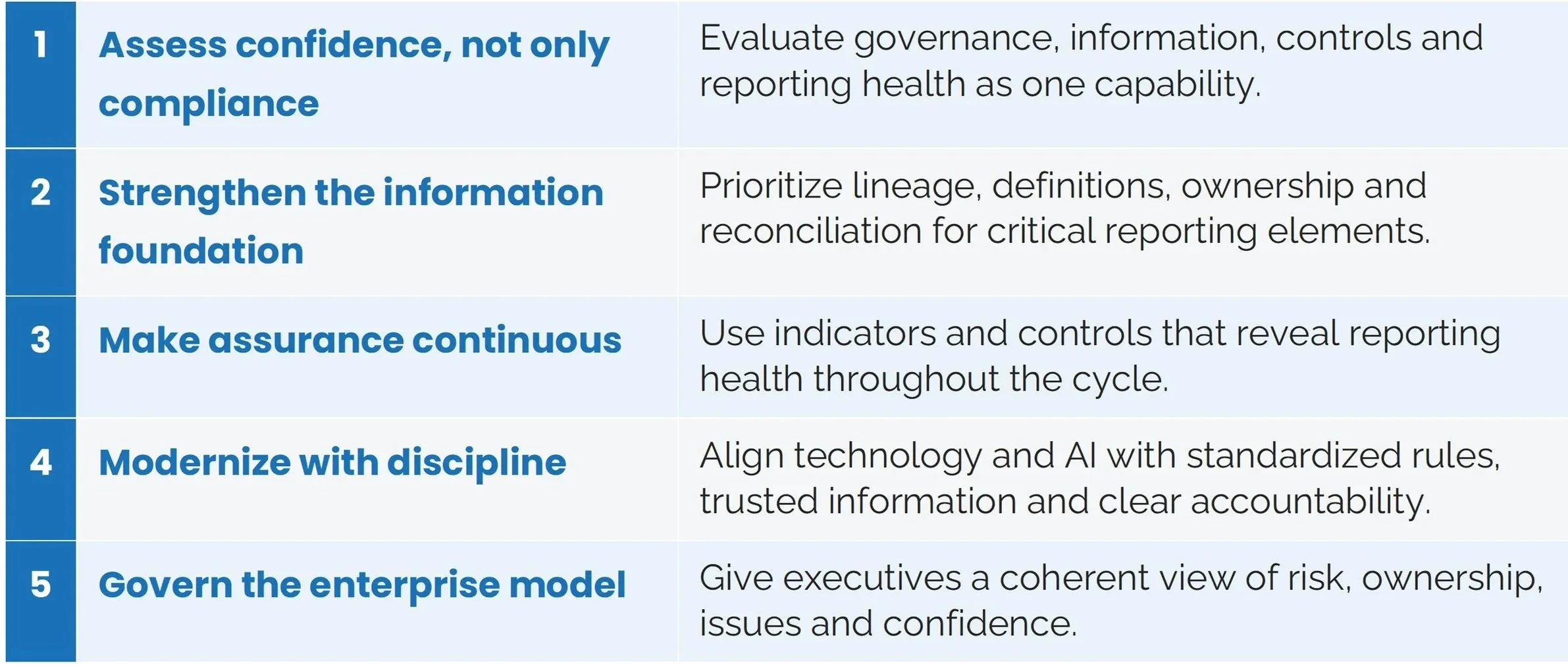
A practial leadership agenda
Closing thoughts
Confidence is built before the report is produced
Regulatory reporting will continue to evolve. Requirements will become more sophisticated, supervisory expectations will expand and technology will reshape how institutions collect, govern, analyze and report information.
Institutions that respond by strengthening governance, improving information quality, integrating operating models and investing in sustainable capability will be better positioned to meet those expectations. They will also improve the information supporting executive decisions across the enterprise.
Trusted regulatory reporting is not achieved through better report production alone. It is achieved by building the governance, information management, controls and organizational disciplines that make trusted reporting possible.
Ultimately, the differentiator will not be the ability to state that a report is complete, accurate and timely. It will be the ability to demonstrate why the information, governance and operating model supporting every reported value deserve confidence.
How Katalysys Can Help
From stronger reports to sustainable Regulatory Confidence
“Building Regulatory Confidence requires more than improving individual returns. It requires stronger governance, information management, controls and operating disciplines across the enterprise”
Katalysys combines regulatory expertise with practical governance, process, information management and transformation experience. Our services are organized around five complementary areas.
01 ASSESS
Understand the current environment
Evaluate reporting maturity across governance, information quality, controls, accountability, operating model and technology.
Representative services
Regulatory Reporting Maturity Assessments
Regulatory Confidence Assessments
Governance and Accountability Reviews
Data Lineage and Information Quality Assessments
Regulatory Reporting Health Checks
02 STRENGTHEN
Build the disciplines that support trusted reporting
Clarify ownership, improve interpretation, strengthen information quality and establish consistent reporting practices.
Representative services
Regulatory Reporting Governance
Regulatory Interpretation Frameworks
Policies and Standards
Data Quality and Reconciliation Frameworks
Control Design and Enhancement
03 MODERNIZE
Align technology with a trusted operating model
Connect reporting architecture, data strategy, automation and AI investments to sustainable governance and business processes.
Representative services
Reporting Architecture Assessments
AI Readiness Assessments
Regulatory Data Strategy
Reporting Platform Evaluations
Target Operating Model Design
04 GOVERN
Give leadership meaningful oversight
Design governance structures that improve transparency, accountability and management insight into reporting health.
Representative services
Executive Reporting Frameworks
Regulatory Reporting Dashboards
Governance Committee Design
Reporting Issue Management
Performance Metrics and Key Risk Indicators
05 TRANSFORM
Create sustainable enterprise capability
Connect modernization, enterprise data, AI, finance transformation and risk initiatives into coherent operating models.
Representative services
Regulatory Reporting Transformation
Enterprise Operating Model Design
Regulatory Remediation Programs
Regulatory Data Transformation
Continuous Improvement Initiatives
“OUR FOCUS: We help clients build the governance, information and operating disciplines that sustain Regulatory Confidence over time - not simply improve a single reporting cycle.”
Ready to build regulatory confidence, please contact:


Anindya Ghosh Chowdhury
Chief Growth Officer (UK)
T: +44 (0)7407 679 600
E: anindya.gchowdhury@katalysys.com