Executive Summary
Regulatory compliance is entering its most significant period of transformation in decades. The objective - complying with the law - hasn't changed, but the environment has: supervisory expectations are expanding, regulatory change is accelerating, and Boards now expect compliance functions to explain risk and support decisions, not simply document adherence.
The deeper challenge is regulatory information itself. A single regulation can touch multiple business lines, products, and control environments, and obligations increasingly overlap across regulators and jurisdictions. Understanding one requirement in isolation is no longer enough.
This is changing what Regulatory Mapping is for. It has long served to identify applicable regulations and demonstrate coverage - useful but limited. Leading institutions now use it to connect obligations to the policies, processes, risks, controls, and governance forums they influence, turning regulatory information into an enterprise asset rather than static documentation.
We call this evolution Regulatory Intelligence: the ability to organize, connect, and use regulatory information to assess business impact, manage regulatory change, and support enterprise governance.
This Executive Briefing examines six forces that are reshaping the future of regulatory compliance.
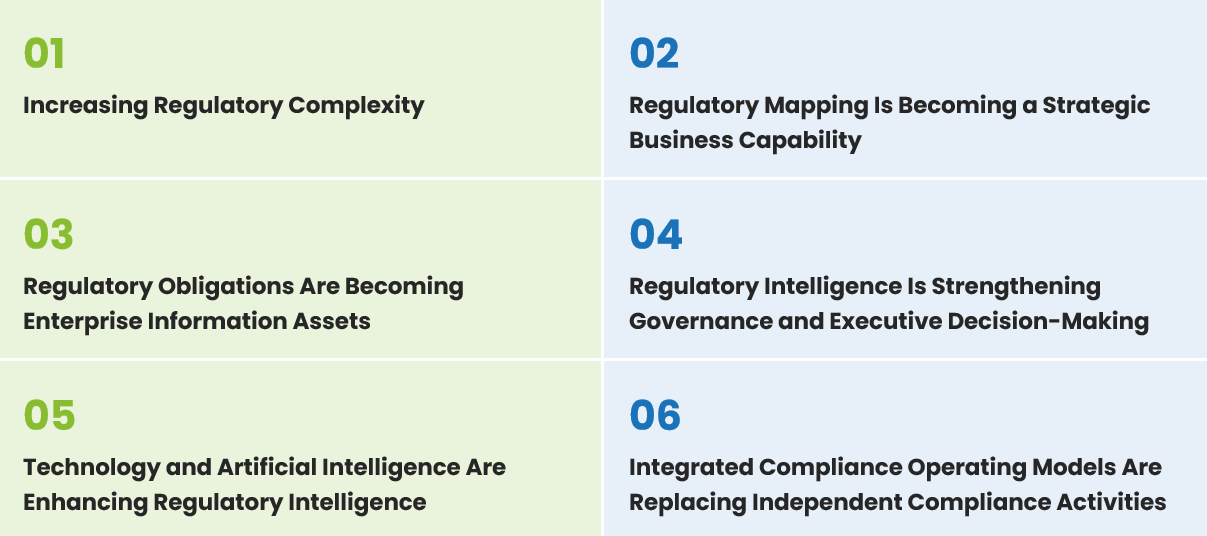
Taken together, these forces point to one conclusion: regulatory compliance is becoming increasingly information-driven. Institutions that organize and connect regulatory information will govern more effectively, adapt faster, and make better decisions.
For Boards and executive leadership, the question isn't whether to keep pace with regulatory change -it's whether today's compliance capability is built for tomorrow's business.
Why regulatory compliance is enetering a new era?
Regulatory compliance is undergoing a fundamental shift. For years, compliance programs focused on interpreting requirements, implementing controls, and demonstrating adherence. Those responsibilities remain essential - but the environment around them has changed.
New regulations rarely replace old ones; they layer on top. Supervisory expectations now extend beyond technical compliance to governance, operational resilience, data quality, and enterprise accountability. A single regulatory development can touch onboarding, products, technology, third parties, controls, and Board reporting at once - understanding these relationships is now as important as understanding the regulation itself.
This changes the role of compliance. Executives no longer want confirmation that a regulation was implemented - they want to know where the greatest risk sits, which initiatives deserve investment, and whether governance is keeping pace. Answering that requires organized regulatory information, not just regulatory expertise.
This is where Regulatory Mapping is changing. It has historically served to identify applicable regulations and document obligations - useful, but limited. Leading institutions now use it to connect obligations to the policies, processes, risks, controls, and governance forums they influence, so regulatory information can be maintained, understood across functions, and used to support decisions.
Viewed this way, Regulatory Mapping stops being a compliance exercise and becomes a business capability: the mechanism that turns regulatory information into Regulatory Intelligence.
The Katalysys regulatory intelligence framework
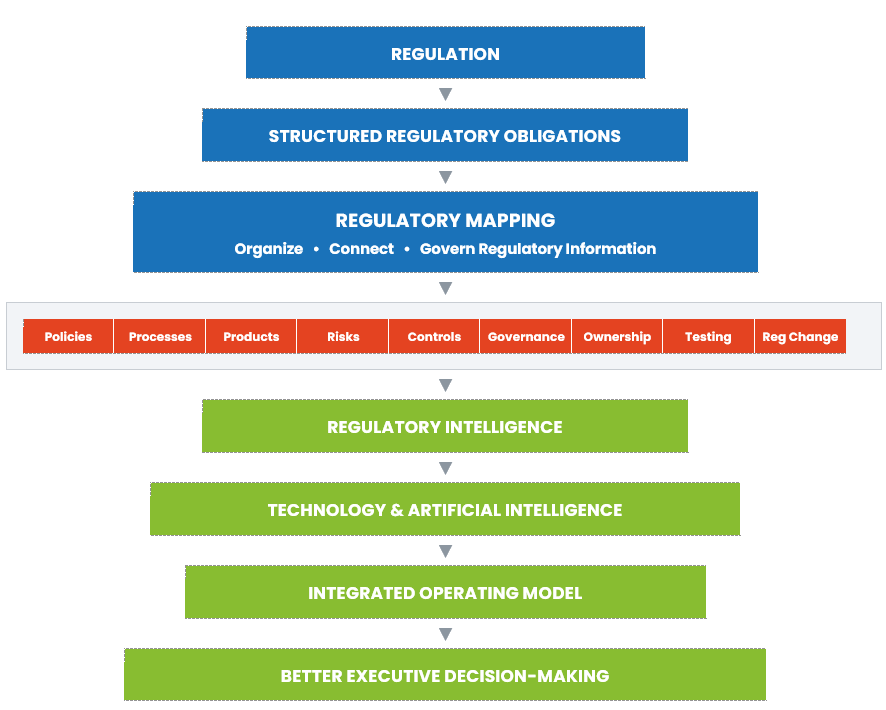
Transforming regulatory information into Regulatory Intelligence that supports better executive decision-making
The six forces reshaping regulatory compliance, and how the Katalysys Regulatory Intelligence Framework helps institutions address them are outlined below.
FORCE 1 Increasing Regulatory Complexity
What’s Changing?
Regulatory complexity is now a defining feature of financial services. Institutions face an expanding volume of laws, guidance, and enforcement actions from multiple domestic and international authorities - and new requirements rarely replace old ones; they layer on top of an already dense environment.
Regulation itself is evolving. Regulators increasingly expect institutions to demonstrate strong governance, enterprise accountability, operational resilience, and high-quality data - not simply technical adherence to individual rules - and these expectations cut across business functions.
The result is a level of interconnectedness that didn't exist a decade ago. A single regulatory development can affect customer onboarding, product governance, technology, third-party relationships, internal controls, and Board reporting simultaneously.
The challenge is no longer understanding regulations. The challenge is understanding how regulations affect the business.
Why It Matters
Complexity creates challenges that extend beyond the compliance function. As requirements interconnect, institutions must coordinate across business lines, risk, technology, legal, and internal audit. Without a shared understanding of obligations, distinct functions interpret the same requirement differently, creating duplication and inconsistent implementation.
Organizations that cannot organize regulatory information struggle to assess the impact of change, identify priorities, or give leadership a clear view of enterprise risk - traditional documentation and manual processes cannot keep pace.
The objective is no longer simply to keep up with regulatory change. It is to build the visibility needed to make better decisions as complexity continues to grow.
QUESTIONS BANKING LEADERS SHOULD CONSIDER
How effectively do we understand the cumulative impact of regulatory requirements across the enterprise?
Can we quickly identify which business functions, products, and controls are affected by a significant regulatory change?
Do distinct functions share a common understanding of regulatory obligations, or do separate interpretations exist across the organization?
Are we managing increasing complexity - or simply adding new compliance activities?
KATALYSYS INSIGHT
Regulatory complexity cannot be eliminated - but it can be organized and managed. Institutions with a disciplined approach to regulatory information are better positioned to strengthen governance and respond to a complex environment with confidence.
FORCE 2 Regulatory Mapping Is Becoming a Strategic Business Capability
What’s Changing?
For years, Regulatory Mapping has been treated as a compliance documentation exercise: identify applicable regulations, interpret requirements, document obligations, demonstrate coverage. These activities remain fundamental - but the environment around them has changed.
Regulatory obligations no longer sit in isolation. They increasingly touch business processes, products, operational risk, technology, controls, and strategic initiatives at once, requiring a more structured way to understand the relationships between them.
This is expanding what Regulatory Mapping does. Rather than serving only as a record of requirements, it is becoming the strategic capability through which regulatory information is organized - translated into structured obligations and linked to the policies, processes, risks, controls, and governance forums they influence.
The objective is no longer simply to demonstrate that regulations have been reviewed. It is to organize regulatory information so it can be maintained, understood, and used to support better decisions across the organization.
Why It Matters
Regulatory information creates value only when it's organized. Institutions already have significant regulatory knowledge - legal inventories, policies, controls, governance committees, regulatory change programs. The opportunity is not to create more information, but to organize what already exists so it can be applied consistently across the enterprise.
When obligations are developed consistently and connected to the activities they influence, Compliance, Legal, Risk, Internal Audit, Operations, and the business can evaluate change, coordinate implementation, and strengthen governance from a common foundation.
The benefits go beyond documentation: new requirements are evaluated faster, ownership is clearer, and executive management gains real visibility into implementation priorities and emerging risk.
QUESTIONS BANKING LEADERS SHOULD CONSIDER
Is Regulatory Mapping viewed as a documentation exercise, or as a capability that supports better decisions?
Can we clearly trace how regulatory obligations affect our products, processes, risks, and controls?
How quickly can we assess the enterprise impact of a significant regulatory change?
Do Compliance, Legal, Risk, Internal Audit, and the business share a common understanding of obligations?
KATALYSYS INSIGHT
Most institutions have already invested heavily in legal inventories and mapping processes. The opportunity now is not to create more regulatory information - it's to make what already exists more valuable. The purpose of Regulatory Mapping is not to document regulations - it is to organize information so institutions can make better decisions.
FORCE 3 Regulatory Obligations Are Becoming Enterprise Information Assets
What’s Changing?
Regulatory obligations have traditionally been viewed as the output of interpretation: Compliance and Legal identify applicable regulations, document obligations, and hand them to the business for implementation. That role remains essential.
Increasingly, though, obligations serve a broader purpose. Each one describes how the organization is expected to operate - collectively, they define expectations for governance, products, operational processes, risk management, and executive oversight. Viewed individually, obligations establish compliance requirements. Viewed collectively, they become an enterprise information asset.
This is changing how leading institutions approach Regulatory Mapping. Rather than maintaining obligations solely to demonstrate coverage, they're placing greater emphasis on obligations that are structured, consistent, and capable of supporting multiple business activities.
As regulatory expectations expand, the quality of an institution's obligations - and how they're organized - will increasingly determine the effectiveness of the broader compliance program.
Why It Matters
Well-structured obligations create a common regulatory language. Rather than each function interpreting requirements independently, Compliance, Legal, Risk, Internal Audit, Operations, and the business can work from the same understanding - reducing duplication and conflicting interpretation.
A single obligation can support policy development, risk assessments, control design, regulatory change, testing, and governance reporting. As more activities rely on the same foundation, institutions gain consistency across the entire compliance lifecycle.
In this way, regulatory obligations become more than documentation - they become the foundation on which Regulatory Intelligence is built.
QUESTIONS BANKING LEADERS SHOULD CONSIDER
Are regulatory obligations defined consistently across the enterprise?
Can multiple functions rely on the same obligations, or do different interpretations exist?
Do obligations support governance, risk, and controls - not just compliance activities?
Are we managing obligations as documentation, or as enterprise information assets?
KATALYSYS INSIGHT
The quality of a compliance program depends, in part, on the quality of the obligations it's built on. Institutions that invest in consistent, well-structured obligations create a stronger foundation for governance, regulatory change, and Regulatory Intelligence.
FORCE 4 Regulatory Intelligence Is Strengthening Governance and Executive Decision-Making
What’s Changing?
Regulatory reporting has historically focused on demonstrating that requirements were implemented, controls were operating, and issues were being remediated. These activities remain fundamental.
Executive leadership, though, is asking different questions. Rather than focusing on implementation status, Boards and executive committees want to understand where the greatest regulatory risk sits, which initiatives deserve investment, and how regulatory change may shape future business decisionsSanctions compliance has evolved from a relatively stable activity into a rapidly changing operational capability requiring continuous monitoring, agile governance, and timely implementation.
These questions require more than regulatory knowledge - they require Regulatory Intelligence. As information becomes better organized and connected, institutions can move beyond reporting individual activities toward understanding the relationships between regulation, operations, risk, and strategy.
This is an important evolution in governance: compliance reporting is becoming less about documenting completed work and more about helping leadership see where attention and investment are needed.
Why It Matters
Executive leadership doesn't make decisions one regulation at a time - it makes decisions about strategy, investment, and risk. Supporting those decisions requires information that explains how regulation affects the organization, not simply whether individual activities are complete.
When information is organized consistently, leadership gains a genuinely integrated view of enterprise regulatory risk - understanding where obligations overlap, where responsibilities intersect, and where initiatives deserve the greatest attention.
This shifts governance conversations from monitoring compliance activity toward understanding how regulation shapes business performance and long-term strategy.
QUESTIONS BANKING LEADERS SHOULD CONSIDER
Does executive management receive information that explains business impact, or simply describes completed activity?
Can leadership identify which regulatory developments are most likely to shape strategic priorities?
Are governance discussions focused on reporting past work, or informing future decisions?
Are we giving leadership regulatory information - or Regulatory Intelligence?
KATALYSYS INSIGHT
The value of Regulatory Intelligence is measured by the quality of the decisions it supports. The question is no longer whether institutions have enough regulatory information. It is whether they have the Regulatory Intelligence needed to make better business decisions.
FORCE 5 Technology and Artificial Intelligence Are Enhancing Regulatory Intelligence
What’s Changing?
Technology is now integral to regulatory compliance. Institutions continue to invest in GRC platforms, regulatory change tools, and analytics, and Artificial Intelligence is opening new ways to monitor regulatory change and identify relationships across large volumes of information.
Tasks that once required significant manual effort can increasingly be automated - institutions can process regulatory information faster, spot emerging issues earlier, and give leadership broader insight into the regulatory environment.
But technology is shifting from supporting compliance activity to supporting Regulatory Intelligence. As information becomes more structured, technology can do far more than automate existing processes - it can help institutions understand relationships and evaluate impact across the enterprise.
The institutions that benefit most from AI will not be those with the most advanced technology. They will be those with the strongest information foundation.
Why It Matters
Technology doesn't create Regulatory Intelligence - it enables institutions to use it more effectively. AI can summarize regulations and accelerate analysis, but its output depends entirely on the quality of the information it receives. Poorly organized information produces inconsistent results, regardless of the technology behind it.
This is changing how institutions think about technology investment. The greatest long-term value increasingly comes not from selecting new platforms, but from improving the quality of the regulatory information those platforms manage.
Well-structured obligations and strong information governance create the foundation on which technology delivers real business value - extending regulatory expertise rather than replacing it.
QUESTIONS BANKING LEADERS SHOULD CONSIDER
Is our regulatory information organized well enough to support AI effectively?
Are technology investments improving decision-making, or simply automating existing activity?
Have we invested as much in information governance as in compliance technology?
Are we preparing our technology for the future - or preparing our information for it?
KATALYSYS INSIGHT
Artificial Intelligence has real potential to transform regulatory compliance - but its greatest contribution won't come from replacing regulatory expertise. Technology enables Regulatory Intelligence. It does not create it.
FORCE 6 Integrated Compliance Operating Models Are Replacing Independent Compliance Activities
What’s Changing?
Financial institutions have invested heavily in strengthening individual compliance capabilities - Regulatory Change, Policy Management, Regulatory Mapping, Risk Assessments, Internal Audit, and Governance have each matured significantly. Each remains essential.
But strengthening individual activities doesn't necessarily strengthen the compliance program as a whole. The greatest opportunity lies in improving the operating model that connects them.
When regulatory information is organized consistently, individual functions stop operating independently. Regulatory obligations become a shared foundation supporting Regulatory Change, Risk, Controls, Internal Audit, Governance, and executive reporting.
This is an important evolution in the operating model itself: compliance is becoming less a collection of independent activities and more an integrated enterprise capability.
Why It Matters
An integrated operating model improves the quality and consistency of decisions across the organization. When multiple functions rely on the same regulatory information, change can be coordinated more effectively and governance discussions rest on a shared understanding.
The benefits extend beyond efficiency: leadership gains real visibility into enterprise priorities, investment decisions improve, and resources can be allocated with more confidence.
Most importantly, an integrated model lets institutions respond to future regulatory change without rebuilding disconnected activities each time - they adapt an information foundation that already connects obligations, governance, risk, and technology.
QUESTIONS BANKING LEADERS SHOULD CONSIDER
Do our compliance functions operate from a shared understanding of regulatory obligations?
Where do multiple functions maintain duplicate or inconsistent regulatory information?
Does our operating model encourage collaboration across Compliance, Legal, Risk, Internal Audit, and the business?
Are we strengthening individual activities - or the enterprise capability that connects them?
KATALYSYS INSIGHT
The future of regulatory compliance won't be defined by stronger individual functions alone - it will be defined by how effectively those functions operate together. Technology enables Regulatory Intelligence. Integrated operating models enable organizations to act on it.
Looking Ahead: Building the Next Generation of Regulatory Intelligence
The six forces in this Executive Briefing point to one conclusion: regulatory compliance is entering a new phase of maturity.
The objective of complying with the law hasn't changed - but how institutions organize, govern, and use regulatory information is changing rapidly, driven by rising complexity, expanding expectations, and advancing technology.
The next stage of compliance won't be defined by larger legal inventories or another standalone technology implementation. It will be defined by how effectively institutions organize regulatory information, connect compliance capabilities, and turn information into Regulatory Intelligence.
This doesn't require a large-scale transformation initiative for every institution. For many, meaningful progress comes through targeted improvements: strengthening Regulatory Mapping, improving the quality of obligations, or integrating compliance capabilities. Wherever an institution begins, the direction is clear: organizations that treat regulatory information as a strategic asset will be better positioned to respond to change, strengthen governance, and make more informed decisions.
KATALYSYS INSIGHT
The future of regulatory compliance will not be defined solely by technology, or solely by regulation. It will be defined by an institution's ability to organize regulatory information, transform it into Regulatory Intelligence, and embed that intelligence within an integrated operating model. Technology enables Regulatory Intelligence. Integrated operating models enable organizations to act upon it. Better decisions are the result.
How Katalysys Can Help
Every institution begins from a different point in its regulatory compliance journey - modernizing Regulatory Mapping, strengthening governance, or building a more integrated operating model.
Increasingly, senior leaders are asking a broader question:
“How do we transform regulatory compliance from a series of independent activities into a capability that supports better business decisions?”
Katalysys helps financial institutions answer that question through practical advisory services that strengthen Regulatory Intelligence and improve enterprise compliance capabilities. Our work focuses on six areas.
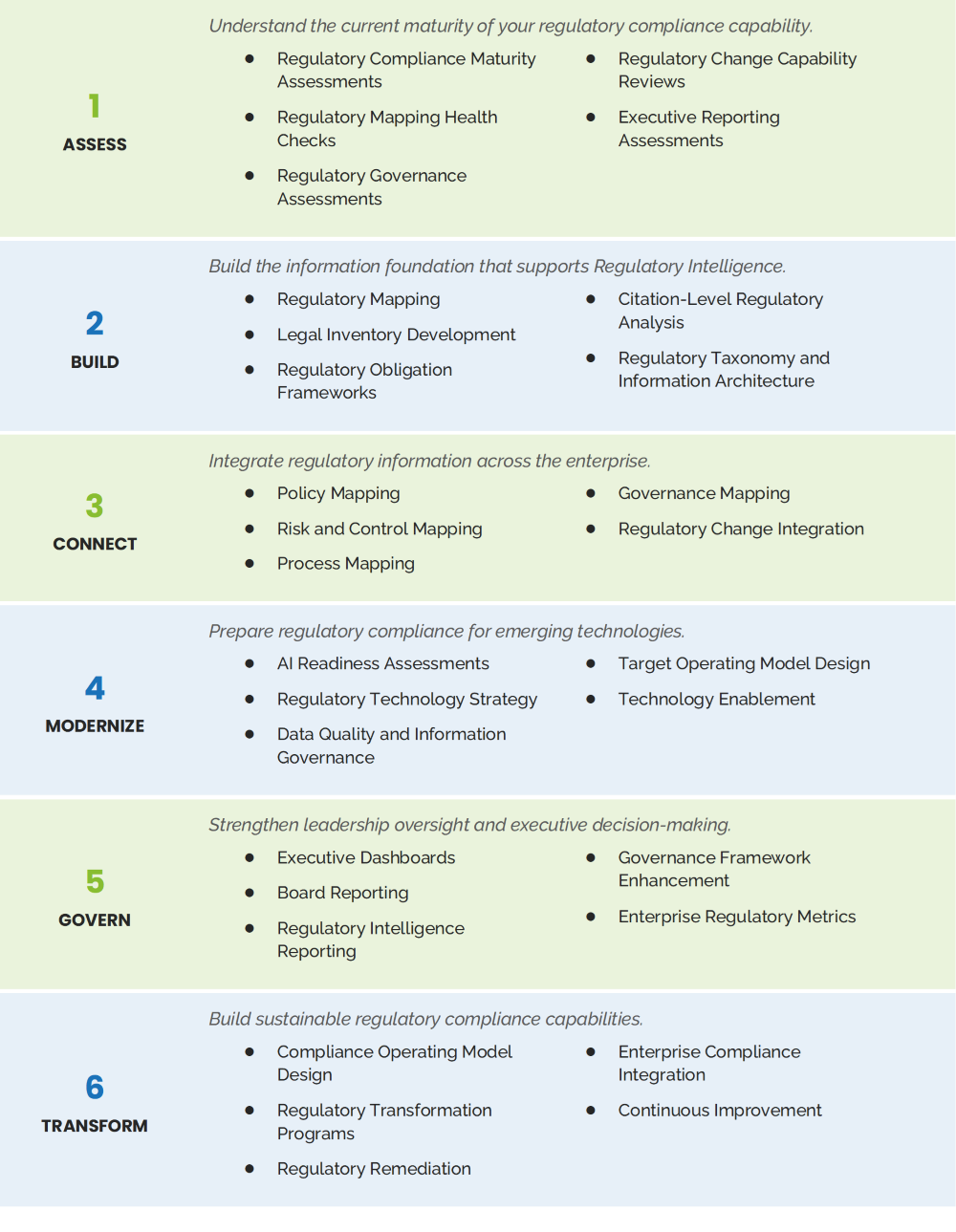
The opportunity isn't simply to respond to regulatory change - it's to organize regulatory information in ways that strengthen governance and support better executive decision-making.
“The future of regulatory compliance will be defined by an organization’s ability to organize regulatory information, transform it into Regulatory Intelligence, and embed that intelligence within an integrated operating model that supports better decisions.”