
From Regulatory Remediation to Suistainable Regulatory Reporting
Executive Summary
Remediation is becoming operating-model transformation.
Regulatory reporting has become one of the most closely scrutinized capabilities within financial institutions. As regulatory expectations continue to evolve, reporting failures are increasingly viewed not as isolated operational issues, but as indicators of broader weaknesses in governance, data, controls, ownership, technology, and the operating model that supports regulatory reporting. The resulting supervisory findings, remediation programs, and organizational disruption can require significant investments of executive attention, organizational resources, and time.
Traditionally, the primary objective of remediation has been to correct deficiencies, satisfy regulatory expectations, and close supervisory findings. While these outcomes remain essential, they are no longer sufficient. Institutions that limit remediation to corrective action often resolve today's issues without addressing the underlying operating model weaknesses that contributed to them. As a result, they remain vulnerable to recurring deficiencies, increasing supervisory expectations, and future remediation efforts.
This Executive Briefing presents a different perspective.
Regulatory remediation should not be viewed solely as the resolution of supervisory findings. It should be viewed as the catalyst for transforming the operating model that enables sustainable regulatory reporting.
By strengthening governance, ownership, risk management, controls, data, technology, and accountability, institutions can transform remediation from a reactive exercise into a strategic investment. The result is more than compliant reporting—it is a more resilient organization, better informed decision-making, greater operational efficiency, and a reduced likelihood of future remediation.
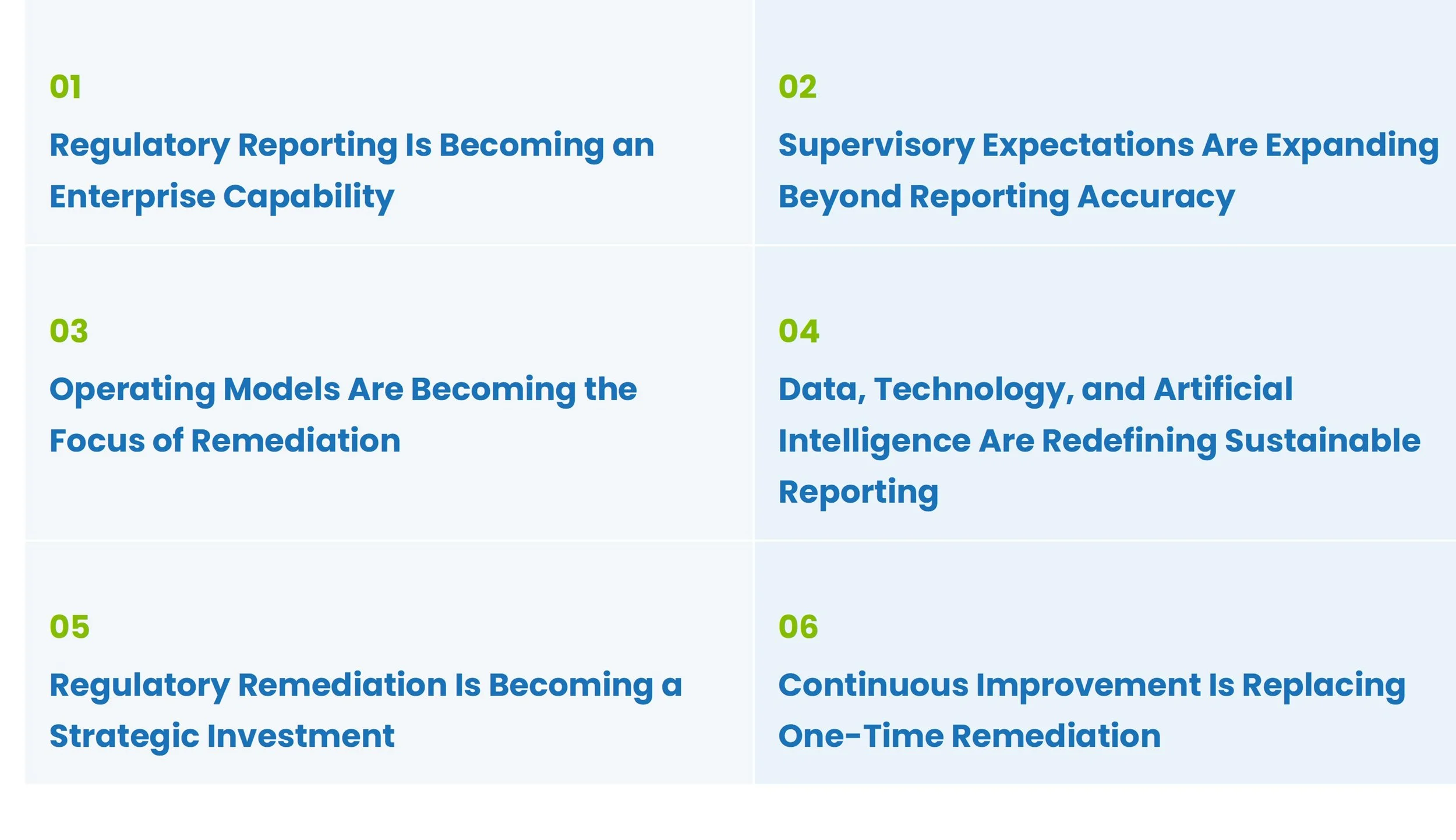
This Executive Briefing explores six forces that are reshaping regulatory reporting remediation and introduces The Katalysys Regulatory Reporting Remediation Framework, which provides guidance for financial institutions to take corrective action toward sustainable regulatory reporting through operating model transformation. Together, they provide a practical roadmap for organizations seeking not only to resolve today's supervisory findings, but to emerge from remediation stronger, more resilient, and better prepared for the future.
“Regulatory remediation should be viewed as the catalyst for transforming the operating model that enables sustainable regulatory reporting.”
Six forces are reshaping regulatory reporting
Why regulatory reporting remediation is entering a new era
The objective has moved beyond closing findings.
Regulatory reporting has always been a critical responsibility for financial institutions, but the expectations surrounding it have changed significantly. Regulators no longer evaluate reporting solely by the accuracy and timeliness of individual submissions. Increasingly, they examine the governance, data, controls, ownership, technology, and accountability that support the reporting process itself. A reporting issue is now viewed less as an isolated operational error and more as evidence of how effectively an institution manages the broader operating model behind its regulatory reporting obligations.
For many institutions, remediation has traditionally focused on addressing the specific findings identified by regulators. Reports are corrected, controls are strengthened, documentation is updated, and supervisory commitments are fulfilled. These actions remain essential, and institutions must continue to respond decisively whenever reporting deficiencies are identified.
The expectations, however, have changed.
Regulators increasingly expect institutions not only to correct individual deficiencies, but also to demonstrate that they understand why those deficiencies occurred and have addressed the broader organizational conditions that allowed them to develop. The focus has expanded from individual reporting errors to the effectiveness of governance, accountability, data quality, risk management, and the operating model that supports regulatory reporting. Resolving today's issue is important. Demonstrating that similar issues are less likely to occur tomorrow has become equally important.
This represents an important shift in how remediation should be viewed.
Rather than asking, "How quickly can we close this finding?" leading institutions are increasingly asking a different question:
"How can this remediation strengthen our regulatory reporting capability for the future?"
That question changes everything.
It changes the objective of remediation from correcting deficiencies to strengthening the organization. It changes investment decisions from short-term corrective actions to long-term operating model improvements. Most importantly, it changes how success is measured. The most successful remediation programs are not those that simply satisfy supervisory expectations—they are those that leave the institution with stronger governance, clearer ownership, better controls, higher-quality data, more effective technology, and a more resilient regulatory reporting operating model than existed before the issue was identified.
This is the opportunity.
Regulatory remediation should not be viewed simply as the resolution of supervisory findings. It should be viewed as the catalyst for transforming the regulatory reporting operating model, enabling institutions to move beyond corrective action toward sustainable regulatory reporting.
The business impact of regulatory reporting failures
The reporting error is rarely the greatest consequence.
Every financial institution experiences reporting issues. Most are identified and resolved through established governance processes before they become significant supervisory concerns. Others, however, reveal broader weaknesses in the operating model that supports regulatory reporting. When that occurs, the consequences often extend well beyond the report itself.
A significant regulatory reporting failure may result in supervisory findings, Matters Requiring Attention (MRAs), Matters Requiring Immediate Attention (MRIAs), enforcement actions, consent orders, or other forms of heightened regulatory oversight. Depending on the nature and severity of the issue, institutions may also face increased scrutiny, delayed strategic initiatives, restrictions on business activities, or requirements to undertake extensive remediation programs. While the specific regulatory response will vary, one reality remains consistent: regulatory reporting failures demand the attention of senior leadership.
The reporting error is rarely the greatest consequence.
The greater challenge is the organizational effort required to recover from it.
Executive attention shifts toward governance meetings, regulatory interactions, remediation planning, and ongoing oversight. Technology investments may be redirected to strengthen data quality and reporting infrastructure. Business leaders, Risk, Finance, Operations, Compliance, and Technology must work together to investigate root causes, redesign processes, enhance controls, and demonstrate sustainable improvement. Resources that might otherwise support innovation, growth, or strategic priorities are redirected toward restoring regulatory confidence.
Viewed this way, remediation is not simply a compliance activity.
It becomes an enterprise initiative.
That distinction matters because enterprise initiatives create enterprise opportunities. The work required to resolve a regulatory reporting issue frequently exposes opportunities to clarify ownership, strengthen governance, improve data quality, modernize technology, enhance controls, streamline processes, and reinforce accountability across the organization. These improvements extend far beyond the immediate supervisory finding and often strengthen the institution's overall operating model.
This is where leading institutions begin to think differently.
Rather than viewing remediation solely as the cost of correcting a reporting failure, they view it as an investment in building a stronger organization. The resources committed to remediation are no longer measured only by their ability to satisfy today's supervisory expectations, but by their ability to improve tomorrow's governance, operating model, decision-making, and regulatory reporting capability.
Organizations cannot always prevent regulatory reporting failures.
They can decide what those failures become.
“LEADERSHIP LENS
Rather than viewing remediation solely as the cost of correcting a reporting failure, they view it as an investment in building a stronger organization. The resources committed to remediation are no longer measured only by their ability to satisfy today’s supervisory expectations, but by their ability to improve tomorrow’s governance, operating model, decision-making, and regulatory reporting capability.
”
Six forces reshaping the future of regulatory reporting remediation
Six forces are changing the purpose of regulatory remediation.
The changing expectations surrounding regulatory reporting remediation are not the result of a single regulatory initiative or supervisory trend. They reflect a broader transformation taking place across the financial services industry. Regulatory reporting has become increasingly dependent on enterprise governance, high-quality data, integrated technology, effective controls, and clearly defined accountability. As these expectations continue to evolve, institutions are rethinking not only how they produce regulatory reports, but how they design the operating model that supports them.
This shift is changing the purpose of remediation itself. Correcting reporting deficiencies remains essential, but leading institutions increasingly recognize that remediation creates an opportunity to strengthen the broader capabilities that enable sustainable regulatory reporting. Success is measured not simply by the closure of supervisory findings, but by the resilience of the operating model that emerges once remediation is complete.
FORCE 1 Regulatory Reporting Is Becoming an Enterprise Capability
What’s Changing?
Regulatory reporting was once viewed primarily as the responsibility of Finance or Regulatory Reporting teams. While those functions remain central to the reporting process, the quality of regulatory reporting increasingly depends on activities that extend far beyond report preparation itself. Governance, data management, technology, operational processes, risk management, internal controls, ownership, and executive oversight all contribute to the reliability of regulatory reporting.
This broader perspective is changing how regulators evaluate reporting programs. Reporting deficiencies are increasingly viewed not simply as reporting errors, but as indicators of weaknesses elsewhere in the organization. A recurring data quality issue may reflect deficiencies in governance. An unsupported adjustment may reveal weaknesses in controls. Incomplete documentation may expose unclear ownership or ineffective operating procedures. The report becomes the visible outcome of a much larger operating model.
The question is no longer whether institutions can produce regulatory reports.
The question is whether the operating model behind those reports consistently produces reliable regulatory reporting.
Why It Matters
Viewing regulatory reporting as an enterprise capability fundamentally changes the objectives of remediation. Rather than focusing exclusively on correcting individual reports or satisfying supervisory findings, institutions can address the governance, ownership, data, technology, controls, and accountability that support reporting across the enterprise. Improvements made in these areas strengthen not only today's reporting obligations, but also the institution's ability to respond to future regulatory change with greater consistency and confidence.
QUESTIONS BANKING LEADERS SHOULD CONSIDER
Do we view regulatory reporting as a reporting function, or as an enterprise capability?
Are governance, Risk, Finance, Technology, Operations, and Compliance working from a common operating model?
When reporting issues occur, do we focus primarily on correcting reports—or on strengthening the processes and capabilities that produced them?
Will our current operating model continue to support regulatory reporting as supervisory expectations evolve?
KATALYSYS INSIGHT
Sustainable regulatory reporting is not achieved by improving reports alone. It is achieved by strengthening the operating model that produces them.
FORCE 2 Supervisory Expectations Are Expanding Beyond Reporting Accuracy
What’s Changing?
For many years, regulatory reporting examinations focused primarily on the accuracy, completeness, and timeliness of regulatory submissions. While these expectations remain fundamental, supervisory reviews have expanded significantly. Regulators increasingly seek to understand the governance, data lineage, control environment, ownership, documentation, and decision-making processes that support regulatory reporting.
In other words, regulators are no longer evaluating only the reports.
They are evaluating the organization's ability to produce those reports consistently, transparently, and sustainably.
This broader perspective reflects an important reality. Accurate reports can occasionally be produced despite weak governance or inconsistent processes. Conversely, a strong operating model should consistently produce reliable reporting, even as regulations evolve and organizational complexity increases.
Reporting accuracy remains the objective.
Confidence in the operating model has become the expectation.
Why It Matters
Institutions that focus remediation solely on correcting reporting outputs may successfully address today's examination findings while leaving the underlying organizational weaknesses unresolved. Sustainable remediation requires strengthening the governance, controls, and accountability that give regulators confidence in the reporting process itself.
Questions banking leaders should consider
Would regulators have confidence in our reporting process even if they never looked at a single report?
Can we demonstrate clear ownership, governance, and accountability throughout the reporting lifecycle?
Are our remediation efforts improving our operating model - or simply correcting isolated deficiencies?
KATALYSYS INSIGHT
Regulators increasingly evaluate the confidence an institution inspires—not simply the reports it produces.
FORCE 3 Operating Models Are Becoming the Focus of Remediation
What’s Changing?
Historically, remediation programs concentrated on resolving individual findings. Teams investigated root causes, corrected deficiencies, documented improvements, and demonstrated compliance with supervisory expectations.
Today, remediation is becoming considerably broader.
Institutions increasingly recognize that recurring reporting issues often originate from fragmented governance, inconsistent processes, disconnected technology, unclear ownership, or ineffective data management. Addressing individual findings without improving these underlying capabilities rarely produces lasting results.
The operating model has become the remediation.
That shift fundamentally changes the nature of remediation programs. Rather than implementing isolated corrective actions, institutions redesign governance structures, clarify accountability, modernize technology, improve controls, strengthen data management, and establish sustainable reporting capabilities that extend well beyond the original finding
Why It Matters
Organizations that improve their operating model reduce the likelihood of recurring findings while creating efficiencies that benefit many other regulatory and business activities. The value of remediation extends beyond satisfying supervisors - it becomes an investment in institutional resilience.
Questions banking leaders should consider
Are we redesigning the operating model or simply documenting corrective actions?
Which organizational weaknesses continue to create recurring reporting issues?
Will today's remediation still create value after supervisory findings are closed?
KATALYSYS INSIGHT
The strongest remediation programs improve the organization—not just the examination results.
FORCE 4 Data, Technology, and Artificial Intelligence Are Redefining Sustainable Reporting
What’s Changing?
The volume, complexity, and frequency of regulatory reporting continue to increase. At the same time, financial institutions are investing heavily in modern data architectures, workflow automation, analytics, and artificial intelligence to improve reporting quality and operational efficiency.
These technologies are changing more than reporting processes.
They are changing expectations.
Institutions increasingly have the ability to automate data validation, monitor reporting quality continuously, identify anomalies before submission, strengthen governance through workflow management, and improve transparency across the reporting lifecycle. Artificial intelligence introduces additional opportunities to accelerate issue identification, support root cause analysis, improve documentation, and enhance regulatory change management.
Technology alone, however, is not the solution.
Without effective governance, ownership, controls, and accountability, advanced technology simply enables organizations to perform inefficient processes more quickly.
Why It Matters
Technology should strengthen the operating model—not replace it. Organizations that successfully integrate data governance, automation, and artificial intelligence into a well-designed operating model are better positioned to produce reliable reporting while adapting efficiently to future regulatory change.
Questions banking leaders should consider
Does our technology reinforce strong governance and controls?
Are we using AI to enhance decision-making or merely automate existing processes?
How effectively does our data architecture support sustainable regulatory reporting?
KATALYSYS INSIGHT
Technology accelerates performance. Governance determines its direction.
FORCE 5 Regulatory Remediation Is Becoming a Strategic Investment
What’s Changing?
For many institutions, regulatory remediation has historically been viewed as a necessary response to supervisory findings. The objective was straightforward: resolve deficiencies, satisfy regulatory expectations, and close the examination.
Increasingly, however, leading institutions are approaching remediation differently.
Rather than viewing remediation solely as the cost of addressing past deficiencies, they recognize it as an opportunity to strengthen organizational capabilities that create value long after supervisory findings have been closed. Investments in governance, data, technology, controls, ownership, and operating model redesign frequently produce benefits that extend well beyond regulatory reporting, improving operational efficiency, risk management, decision-making, and organizational resilience.
The investment outlives the remediation.
That realization fundamentally changes executive decision-making. Instead of asking how little can be spent to satisfy regulatory expectations, institutions increasingly ask how remediation investments can create lasting enterprise value.
Why It Matters
Organizations that treat remediation as a strategic investment often emerge stronger than they were before the original reporting issue occurred. The resources committed during remediation become investments in future capability rather than expenses associated solely with past deficiencies.
Questions banking leaders should consider
Are remediation investments improving only regulatory reporting, or strengthening broader organizational capabilities?
Which remediation activities will continue creating value after supervisory findings are closed?
Are we measuring remediation success by regulatory closure or by organizational improvement?
KATALYSYS INSIGHT
The value of remediation should be measured not by the findings it closes, but by the capabilities it creates.
FORCE 6 Continuous Improvement Is Replacing One-Time Remediation
What’s Changing?
Regulatory reporting is no longer a static compliance obligation. Regulatory expectations evolve. Business models change. Products become more complex. Data sources expand. Technology continues to advance. Operating models must continually adapt to keep pace.
As a result, remediation can no longer be viewed as a one-time project with a clearly defined endpoint.
It is becoming part of an ongoing cycle of organizational improvement.
Leading institutions increasingly integrate lessons learned from remediation into governance processes, control testing, data management, technology modernization, training, and regulatory change management. Rather than waiting for the next examination to identify weaknesses, they establish operating models capable of identifying, assessing, and addressing issues before they develop into significant supervisory concerns.
Sustainable reporting requires sustainable improvement.
Why It Matters
Organizations that embed continuous improvement into their operating model are better positioned to adapt to future regulatory expectations while reducing the likelihood of recurring findings. Remediation becomes less about recovering from past deficiencies and more about continuously strengthening future capability.
Questions banking leaders should consider
Does our operating model continuously improve, or only respond after issues emerge?
How effectively do we incorporate lessons learned into future reporting processes?
Are we building an organization capable of adapting as regulatory expectations continue to evolve?
KATALYSYS INSIGHT
The strongest operating models are not those that avoid change. They are those that continuously improve because change is inevitable.
From insight to action
How should institutions respond?
Understanding the forces reshaping regulatory reporting remediation is only the first step. Recognizing that remediation is evolving from a corrective exercise into an opportunity for operating model transformation naturally leads to a more practical question:
While every organization begins its remediation journey from a different point, the objective is increasingly the same—to move beyond resolving individual supervisory findings and establish the governance, capabilities, and operating model necessary to support sustainable regulatory reporting.
“PRACTICAL ROADMAP: The Katalysys Regulatory Reporting Remediation Framework provides a structured approach for achieving that objective.”
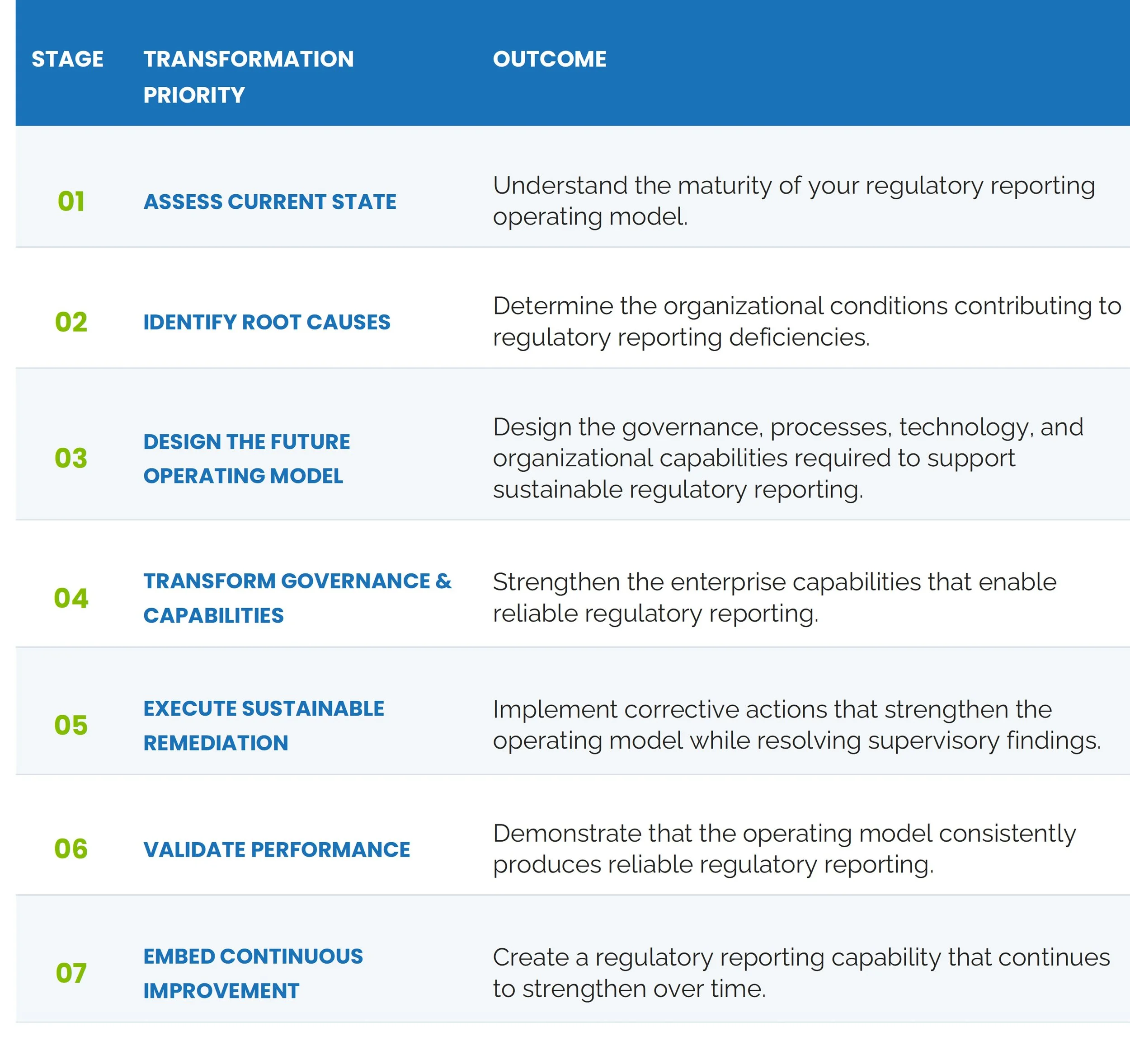
The Katalysys Regulatory Reporting Remediation Framework
The six forces described in this Executive Briefing explain why regulatory reporting remediation is evolving. They illustrate how supervisory expectations, technology, governance, and operating model design are reshaping the way financial institutions approach regulatory reporting.
Understanding these forces, however, is only the beginning.
The more important question is how institutions should respond.
While every remediation program is unique, leading organizations tend to follow a similar progression. They move beyond correcting individual deficiencies and systematically strengthen the governance, capabilities, and operating model that enable sustainable regulatory reporting.
The Katalysys Regulatory Reporting Remediation Framework provides a practical roadmap for that journey.
Looking ahead
Preparedness is a strategic choice.
Regulatory reporting will continue to evolve as supervisory expectations, data, technology, and artificial intelligence reshape the financial services industry. The institutions that will be best positioned for the future will not necessarily be those that experience the fewest reporting issues. They will be those that use remediation as an opportunity to strengthen the governance, capabilities, and operating model that support sustainable regulatory reporting.
The journey from corrective action to sustainable regulatory reporting requires more than closing supervisory findings. It requires a long-term commitment to governance, accountability, continuous improvement, and operating model transformation.
The Katalysys Regulatory Reporting Remediation Framework introduced in this Executive Briefing provides a practical roadmap for that journey. Beginning with an assessment of the current operating model and progressing through root cause analysis, future-state design, capability transformation, sustainable remediation, performance validation, and continuous improvement, the framework enables institutions to move beyond reactive compliance toward a more resilient and sustainable regulatory reporting capability.
Organizations cannot always determine when the next regulatory reporting challenge will occur.
They can determine how prepared they will be when it does.
How Katalysys Can Help
Advisory support aligned to every stage.
Every institution begins from a different point in its regulatory reporting journey. Some are responding to supervisory findings or remediation commitments. Others are proactively strengthening governance, modernizing reporting processes, or preparing for future regulatory expectations.
Increasingly, however, executive leadership is asking a broader question:
How do we transform regulatory remediation from a corrective exercise into a sustainable regulatory reporting capability?
The Katalysys Regulatory Reporting Remediation Framework
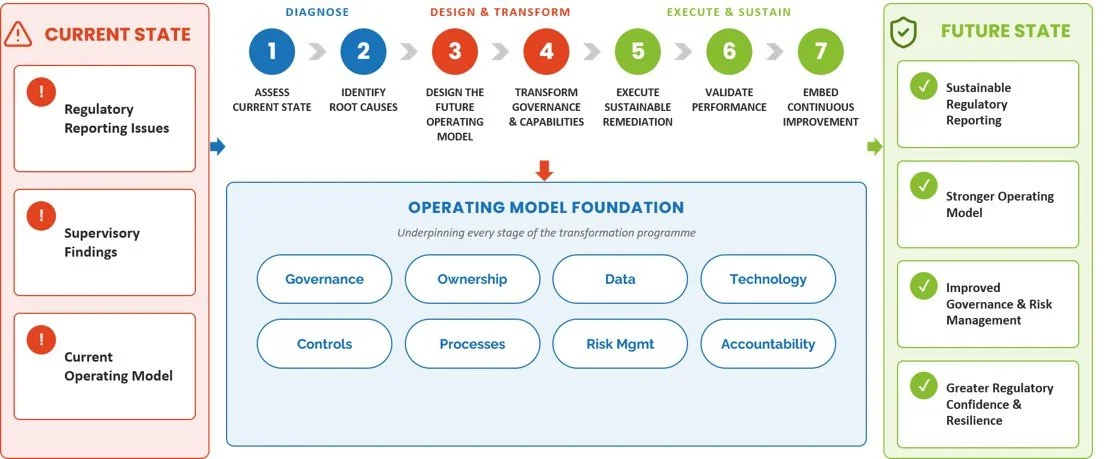
Katalysys helps financial institutions answer that question through practical advisory services aligned to each stage of the Katalysys Regulatory Reporting Remediation Framework. Our objective is not simply to resolve today's reporting issues, but to help institutions strengthen the operating model that supports sustainable regulatory reporting.
01 ASSESS CURRENT STATE
Understand the maturity of your regulatory reporting operating model.
Representative services
Regulatory Reporting Maturity Assessments
Regulatory Reporting Health Checks
Governance & Accountability Assessments
Regulatory Reporting Process Reviews
Data & Control Assessments
02 IDENTIFY ROOT CAUSE
Determine the organizational conditions contributing to regulatory reporting deficiencies
Representative services
Root Cause Analysis
MRA / MRIA Diagnostic Reviews
Regulatory Reporting Gap Assessments
Data Lineage & Issue Analysis
Governance & Control Diagnostics
03 DESIGN THE FUTURE OPERATING MODEL
Design the governance, processes, technology, and organizational capabilities required to support sustainable regulatory reporting.
Representative services
Target Operating Model Design
Governance Framework Design
Regulatory Reporting Process Redesign
Ownership & Accountability Models
Future State Roadmaps
04 TRANSFORM GOVERNANCE & CAPABILITIES
Strengthen the enterprise capabilities that enable reliable regulatory reporting.
Representative services
Governance Transformation
Control Framework Enhancement
Data Governance Improvements
Reporting Process Optimization
Organizational Capability Development
05 EXECUTE SUSTAINABLE REMEDIATION
Implement corrective actions that strengthen the operating model while resolving supervisory findings.
Representative services
Regulatory Remediation Programs
PMO & Program Management
Control Implementation
Data & Technology Enablement
Regulatory Commitment Management
06 VALIDATE PERFORMANCE
Demonstrate that the operating model consistently produces reliable regulatory reporting.
Representative services
Independent Validation
Regulatory Reporting Testing
Control Effectiveness Reviews
Readiness Assessments
Executive Reporting & Regulatory Support
07 EMBED CONTINUOUS IMPROVEMENT
Create a regulatory reporting capability that continues to strengthen over time.
Representative services
Continuous Improvement Programs
Regulatory Change Integration
Operating Model Performance Metrics
Training & Knowledge Transfer
Ongoing Advisory Support
“OUTCOME: The objective is not simply to close supervisory findings. It is to build a stronger regulatory reporting operating model that continues to create value long after remediation has been completed.”
By aligning advisory services to each stage of the Katalysys Regulatory Reporting Remediation Framework, Katalysys helps financial institutions strengthen governance, improve reporting capabilities, modernize operating models, and establish sustainable regulatory reporting that supports long-term regulatory confidence.
Ready to build regulatory confidence, please contact:


Anindya Ghosh Chowdhury
Chief Growth Officer (UK)
T: +44 (0)7407 679 600
E: anindya.gchowdhury@katalysys.com