Basel 3.1 and SDDT: where non-systemic UK banks are on the implementation journey
The industry conversation has moved beyond understanding the rules. The immediate challenge is turning interpretations into calculations, credible regulatory returns and board confidence before 1 January 2027.
The implementation journey:
Across the market, the focus has shifted from analysis to execution. Stages one to four are largely complete for most firms. Work is concentrated in stages five to seven, with stage eight to follow once the first credible parallel-run outputs are available. Some firms are already advanced in configuration and testing; others are still closing core framework and interpretation decisions.
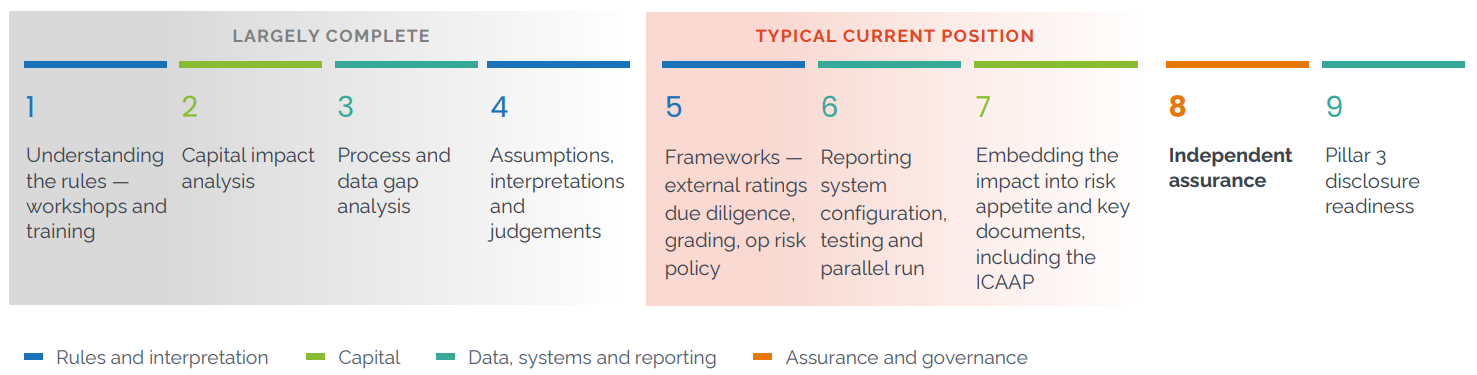
Most firms have largely completed the first four stages and are now focused on framework development, system configuration, parallel runs and embedding the impact into risk appetite, management information and governance documents.
Implementation is iterative: testing will often uncover data issues or assumptions that require earlier decisions to be revisited and documented. Once credible calculations and returns are available, attention should move to independent assurance, potentially using the 30 September 2026 position.
A Practical runway to 1 January 2027:
A planning sequence, not a regulatory timetable. Firms should adapt it to their reporting cycle, the credibility of their parallel-run outputs and the time needed for governance approvals.
-
NowInterpretation and configuration
Close priority interpretations and frameworks; stabilise reporting configuration.
-
30 SeptemberReference date
A practical reference date for a complete, assurance-ready calculation and reporting pack. This is a planning choice, not a regulatory deadline.
-
OctoberReconciliation and remediation
Reconcile outcomes, remediate data and configuration issues, repeat the run and prepare the evidence pack.
-
NovemberIndependent assurance
Undertake independent assurance while there is still time to correct material findings before go-live.
-
DecemberBoard readiness
Obtain board readiness confirmation; close priority actions; approve controlled workarounds and post-go-live remediation where needed.
-
1 January 2027Go-live
Move into the applicable Basel 3.1 or SDDT capital and reporting regime.
The dates above are indicative and set for planning purposes only. Firms with a non-calendar reporting cycle, group reporting dependencies or a longer governance path should shift the sequence backwards accordingly.
Why assurance matters:
Independent assurance is not simply a final compliance check. It gives the board, senior management and other stakeholders a defensible basis for concluding that the implementation works end to end.
Can the numbers be trusted?
Data, lineage, calculations, controls and outputs are complete, accurate and reconcilable.
Can the numbers be explained?
Assumptions, interpretations and judgements are documented, challenged and applied consistently.
Are the numbers proportionate?
The approach is neither under-compliant nor unnecessarily complex or capital-heavy for the business model.
The most useful assurance begins when a credible calculation and reporting pack exists. Starting then allows management to distinguish what must be fixed before go-live, what can be controlled through a temporary workaround and what can move into a governed post-implementation plan. Waiting until December compresses all three decisions into the same window.
Key implementation challenges:
Some of the most difficult items require new evidence, data, policy and control processes that are time-consuming to design and operate.
External ratings due diligence (for non-SDDTs): turning a high-level requirement into a framework, evidence standard and override process.
Unrated institutions: defining how the firm will evidence Grade A, Grade B or Grade C, particularly the qualitative assessment of repayment capacity through an adverse economic cycle and business conditions.
Implicit government support: identifying whether a rating includes support, determining whether an exception applies and deciding what alternative rating or grading path follows.
Currency mismatch: identifying affected retail and residential real estate exposures, evidencing natural or financial hedges, applying proxies and setting an appropriate monitoring frequency.
Off-balance sheet items: reclassifying the full population into the new categories and applying the correct conversion factors, including commitments where drawdown is effectively certain.
Real estate: separating regulatory from other real estate, assessing material dependence on property cash flows, applying revised valuation and LTV mechanics and resolving ADC boundary cases.
Reporting: configuring and testing the new credit, operational risk, market risk and CVA templates, with reconciliations back to source data and capital calculations.
Fine details that are easy to miss:
A small number of details can materially change classification, reporting or risk weight. Click each topic to reveal the implementation direction and test it against the firm's facts.
ADC after completion
The classification is purpose-based. Completion alone does not necessarily change the original financing purpose, so the exposure may remain ADC until it is repaid or refinanced for a different purpose.
Multiple properties
Where an exposure is secured by several properties and any property fails the regulatory real estate conditions, the exposure may need to be treated in full as other real estate rather than split selectively.
Issue ratings and implicit government support
Disregarding an issue-specific rating should not create a more favourable risk weight. The comparison needs to preserve the more prudent outcome.
Counterparty, not exposure class
The restriction on ratings incorporating implicit government support follows the credit institution counterparty. It can therefore remain relevant even where the exposure itself is reported in the corporate class.
Deferred tax assets
The 250% risk weight for amounts below the deduction threshold is familiar. The less obvious implementation point is whether the exposure is being allocated to the correct reporting class.
What impact assessments are telling us:
Across recent capital impact analyses for smaller UK banks, a consistent picture is emerging. The scale of the change varies by book, but the direction of travel is comparable.
Click each risk area to reveal the detail. The findings are directional and drawn from recent engagements with smaller UK banks; they are not a market benchmark.
Credit risk The largest and most portfolio-sensitive movement.
Credit risk is where the outcome varies most from firm to firm, and where the quality and composition of the book matter most.
- Corporates. Firms with higher-rated exposures generally see a reduction in risk weights, while firms with a large SME book that currently benefits from the SME supporting factor tend to see an uplift, driven by the flat 85% risk weight; this uplift can be offset by Pillar 2A rebasing.
- Institutions. Higher-rated counterparties benefit from a lower risk weight; unrated exposures typically require a more conservative grade assumption, given the new grading framework and the shift from residual to original maturity for preferential treatment.
- Real estate. The most complex exposure class. Materially dependent on cash flows attracts higher risk weights, while lower-LTV residential lending can benefit from risk weights below 35%. The currency mismatch multiplier is a further source of uplift for internationally active firms.
- Defaulted exposures. The scope for the 100% risk weight is narrower, and the formula for the provision coverage test now uses the outstanding amount rather than the unsecured portion, which pushes some exposures to 150%.
- Equity. Non high-risk equity moves from 100% to 160% at the start of the transitional period, rising to 250%.
- Off balance sheet. The 0% CCF is gone; unconditionally cancellable commitments now attract a 10% CCF. Trade finance letters of credit generally benefit from the move to a 20% CCF.
Operational risk A Pillar 1 reduction is common.
For smaller firms, the 12% first-bucket coefficient and the 2.25% cap on net interest within the interest component can reduce the business indicator. The PRA's Pillar 2A rebasing may offset some or all of that benefit.
Market risk Usually a small increase in absolute terms.
Most smaller firms have no meaningful trading book and use the simplified standardised approach (SSA). Where market risk is mainly foreign exchange open position, the 1.2 multiplier increases the requirement by 20%.
CVA and counterparty credit risk Usually immaterial in the sample, but the mechanics change.
Firms are typically selecting the alternative approach (AA-CVA) or the basic approach reduced (BA-CVA reduced). For counterparty credit risk, the alpha factor for non-financial counterparties and pension funds moves from 1.4 to 1.
Late change: PS16/26 and the OPRR:
In July 2026, the PRA published PS16/26, finalising consequential Rulebook changes for HM Treasury's Overseas Prudential Requirements Regime (OPRR). The regime replaces the current CRR equivalence architecture with designation of overseas jurisdictions and introduces new terminology for exposures eligible for the institution treatment.
The implementation effect reaches beyond credit risk classification. Firms should revisit the definition used for relevant large exposures, the eligibility of certain collateral, the treatment of unfunded protection providers and the mapping of overseas banks, investment firms, exchanges, sovereigns and public sector entities.
The board-level question:
By late 2026, the question is no longer whether a firm has read the rules or produced a first estimate. It is whether the implementation can survive a full reporting cycle and independent challenge: are the data controlled, are the judgements defensible, are the calculations reproducible, and can management explain the movement from today's numbers to Day 1?
Join the discussion: 15 September 2026
Katalysys will bring together CFOs, CROs, heads of finance and other senior leaders from UK banks for an informal discussion on implementation progress, open judgements and go-live readiness. The questions raised in this article will be explored through peer discussion.
Register here: Katalysys Boardroom Briefing on Basel 3.1 and Climate Risk (15 September 2026)
How We Can Help
Wherever a firm sits on the implementation journey set out above, Katalysys provides specific, practical support to move to the next stage with confidence.
Stages 4 and 5: interpretation and framework design. We help firms set evidence standards for grading, external ratings due diligence, currency mismatch and real estate classification, and document the adopted approaches.
Stage 6: reporting configuration and parallel run. We validate calculations and template mapping against source data, and help firms structure and interpret their parallel-run outputs against the revised reporting templates.
Stage 7: embedding into risk appetite and the ICAAP. We help firms translate the TREA movement into risk appetite metrics, limits and management information, and assess how it flows through to stress testing and buffer requirements.
Stage 8: independent assurance. Coverage of data lineage, assumptions, approach selection and calculations, timed against the November window so findings can be actioned before go-live.
Stage 9: Pillar 3 disclosure readiness. Support for scoping the changes, explaining the new disclosure requirements and linking them to the revised regulatory submissions.
For more information, please contact:

Josh Nowak
CEO & Managing Director - Advisory & Solutions
T: +44 (0)7587 720 988
E: josh.nowak@katalysys.com