Geopolitical Risk for Non-systemic Banks
Overview
Geopolitical risk is moving from a “watch-list topic” to an expected part of banks’ core risk management. Supervisors and industry sources have not prescribed a single framework, but increasingly expect banks to evidence how geopolitical risk is identified, assessed, governed, stress-tested and linked to decisions.
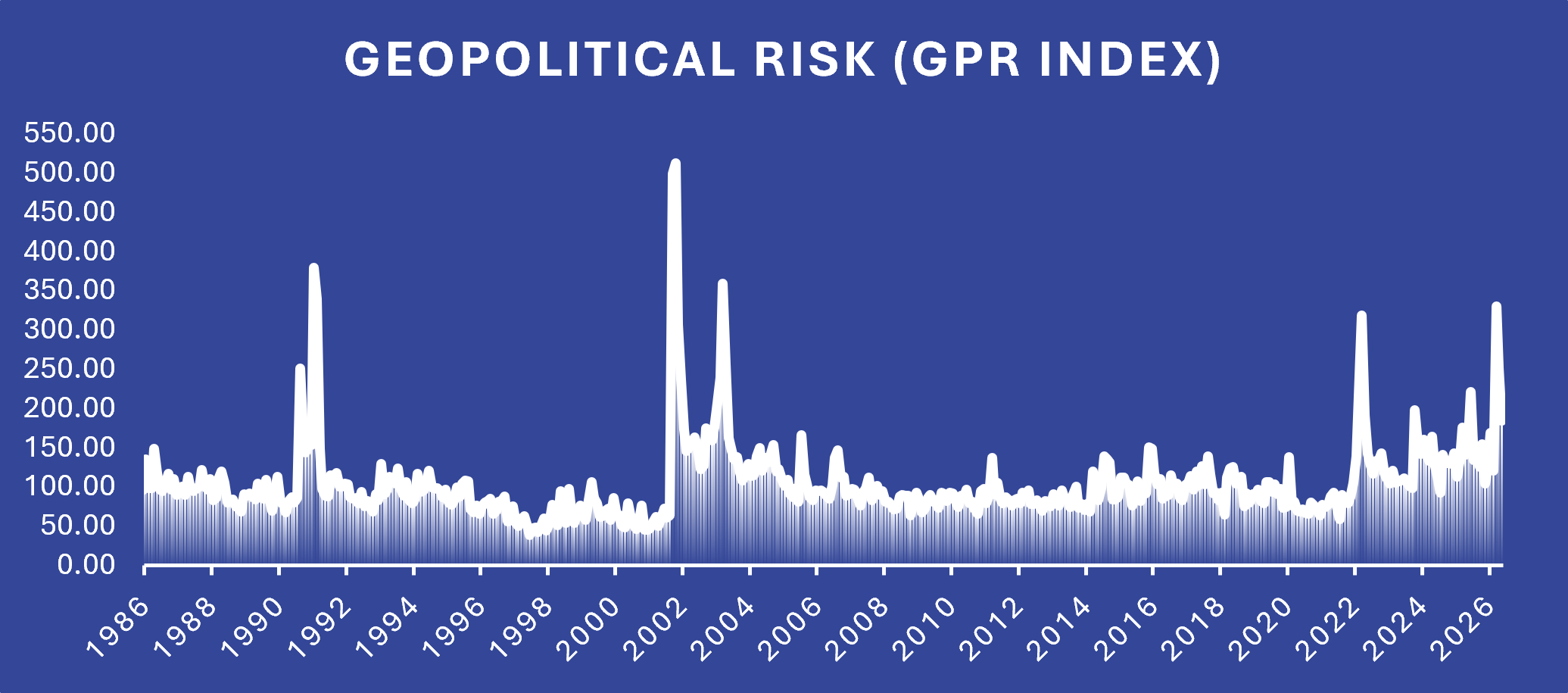
Caldara, Dario and Matteo Iacoviello (2022), “Measuring Geopolitical Risk,” American Economic Review, April, 112(4), pp.1194-1225. Data sourced from https://www.matteoiacoviello.com/gpr.htm on 10 June 2026. The Caldara and Iacoviello GPR index is based on searches of the archives of 10 newspapers. The index is calculated by counting the number of articles related to adverse geopolitical events in each newspaper for each month (as a share of the total number of news articles).
For non-systemic banks, the issue is not about building a standalone geopolitical risk function. A more proportionate response is to treat geopolitical risk as a driver that can amplify existing risk types: credit, liquidity, market, operational resilience, cyber, third-party, reputational, strategic and business model risks.
This direction is supported by regulatory commentary. For example, the ECB describes geopolitical risk as a “cross-cutting risk” driver that can affect traditional banking risks. In practice, this means geopolitical risk should be integrated into the broader risk management framework rather than managed as an isolated risk category. Firms will be familiar with this concept from their more recent consideration of climate-related risk, which also transmits through established risk categories.
What is geopolitical risk?
A common working definition defines geopolitical risk as the threat, realisation and escalation of adverse events associated with wars, terrorism and tensions among states and political entities that affect the peaceful course of international relations (Caldara and Iacoviello (2022), “Measuring Geopolitical Risk”, American Economic Review, 112(4)).
An important distinction is needed between geopolitical risk and geoeconomic fragmentation. Geopolitical risk is the driver: the adverse event, threat or tension. Fragmentation is the outcome: sanctions, trade barriers, capital or technology controls, investment restrictions, reduced cross-border activities and resulting supply chain disruptions.
For banks, this matters because the risk rarely crystallises neatly as “geopolitical risk”. It appears through higher borrower stress, market volatility, sanctions exposure, cyber incidents, third-party failures, payment disruptions, operational resilience issues or reputational concerns.
A structural change
The OECD’s June 2026 Economic Outlook reinforces that geopolitical risk should be treated as a structural macro-financial risk driver rather than a temporary spike. The OECD describes the current Middle East conflict as a dominant force shaping the global economic outlook, with disruption through the Strait of Hormuz and damage to energy infrastructure driving higher energy prices, higher fertiliser and industrial input costs, inflationary pressure, weaker confidence and supply shortfalls.
Importantly for bank risk management and scenario testing, the OECD presents a prolonged disruption scenario in which global growth falls significantly to 2.1% in 2026 and 1.8% in 2027 – with some countries potentially experiencing recession – with higher unemployment, weaker investment and greater risk of financial market repricing. This changes the emphasis from thinking about geopolitical shocks as temporary price and market volatility events.
For non-systemic banks, a proportionate but structured response is warranted. This includes assessing indirect exposures, updating ICAAP and ILAAP assumptions, reviewing ECL and IFRS 9 overlays where appropriate, and ensuring that Board reporting includes clear triggers and management actions.
Carolyn Wilkins’ 2025 Bank of England speech invokes the principle that “a plan beats no plan”. The speech argues that firms should focus less on predicting exactly which geopolitical event will occur and more on the scenarios that could expose the most important vulnerabilities, including financial, operational and system-wide channels.
Transmission channels for non-systemic banks
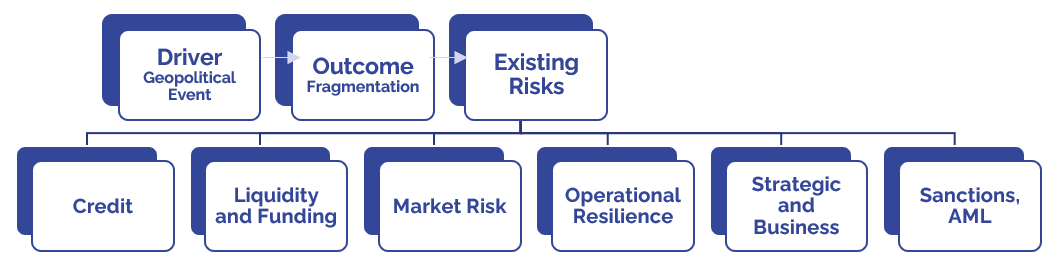
Geopolitical risk is a driver that amplifies existing risks.
| Channel | Transmission Mechanism | Relevance for Firms |
|---|---|---|
| Credit risk | Borrowers face higher input costs, weaker demand, disrupted trade flows, currency volatility and refinancing pressure. | Typically a material channel, especially in corporate and SME lending portfolios. |
| Liquidity and funding risk | Higher funding spreads, reduced wholesale access, higher collateral haircuts, deposit outflows and currency stress. | More pronounced where banks rely on concentrated funding sources, wholesale markets or FX funding. Also relevant for non-cash elements of liquidity buffers. |
| Market risk | Volatility in interest rates, FX, commodities, equities and sovereign spreads. | Market risk may be more limited for non-systemic banks, but remains relevant for IRRBB, treasury portfolios, collateral valuations and any trading book activities. Commodity prices may also feed through to borrower credit risk. |
| Operational resilience | Cyber attacks, payment disruptions, third-party failures, staff safety issues and outsourced service disruptions. | Highly relevant for all firms because third-party, technology, cloud and cyber dependencies can be global. |
| Strategic and business model risk | Reduced profitability, reputational exposure, lower customer demand, market exits or changes in risk appetite. | Relevant for firms with concentrations in sectors exposed to energy, trade, logistics, agriculture, defence, dual-use technology or politically sensitive activities. |
| Sanctions, AML and financial crime | Changing sanctions regimes, trade finance exposures and correspondent banking disruptions. | Relevant for firms with cross-border payments, trade finance, correspondent relationships, higher-risk customer segments or exposure to politically sensitive jurisdictions. |
Direction of supervisory expectations
Our analysis indicates some important shifts in the direction of travel.
First, supervisors are raising the topic even where detailed rules are not yet settled. Geopolitical risk is increasingly prominent in supervisory priorities and plans (see PRA Priorities Letter and PRA Business Plan 2026/27), stress testing, and financial stability commentary.
Second, many firms still evaluate geopolitical risk as an ad hoc exercise rather than as part of the continuous risk management cycle. Progress towards routine integration would improve the quality of risk management and make supervisory engagement easier.
Third, stress testing is, as so often the case, a key tool. Supervisory exercises increasingly incorporate geopolitical tension narratives, including the 2025 Bank of England Bank Capital Stress Test, the 2025 ECB stress test of euro area banks, and the ECB’s planned 2026 geopolitical reverse stress test. Firms are expected to develop capabilities proportionate to their exposures. As with all stress testing, scenarios need to be tailored to the firm’s business model and designed to test specific vulnerabilities.
Fourth, governance is critical. Firms should expect supervisory challenge on ownership, management oversight, escalation, risk appetite and early warning indicators, and management actions where geopolitical risk is material. Geopolitical risk should not sit outside the normal governance cycle.
The ECB’s approach can be summarised as three practical steps: identify the geopolitical events that could affect the institution and its clients; simulate the impact through existing banking risks; and assess whether action is needed.
Proportionality for non-systemic banks
For non-systemic banks, proportionality cannot mean absence. It can, however, mean simpler but structured. A proportionate framework should be capable of answering six questions:
Which geopolitical channels are material to our business model?
Which portfolios, sectors, counterparties, geographies, suppliers and services are most exposed?
What indicators would tell us the risk is escalating?
What would the impact be on our material risk categories?
What decisions would we take, and who owns them?
How do we evidence this to the Board and supervisors?
Proportionate application can focus on a materiality assessment, a small set of carefully chosen indicators, prudently designed scenario analysis, clear governance, and integration into ICAAP, ILAAP, ECL, operational resilience, outsourcing and financial crime processes where relevant.
This is especially important because even banks with limited direct international exposure can be affected indirectly through borrowers, energy prices, inflation, supply chains, financial markets, cyber threats and third-party outsourcing arrangements.
Stress testing
A useful way to think about geopolitical stress testing is to distinguish between forward-looking stress testing and reverse stress testing.
Forward-looking stress testing starts with a plausible scenario. Examples include escalation of conflict, broadening of sanctions, cyberattack on critical infrastructure, energy disruption, severe trade fragmentation or payment system disruption. The bank then estimates the impact on capital, liquidity, profitability and operations. These scenarios can be mapped to variables such as GDP, inflation, unemployment, commodity prices, credit spreads, FX rates and collateral values, then translated into credit provisions, income effects, one-off losses, liquidity impacts and operational disruption.
Reverse stress testing takes the opposite approach. It starts from a point of failure, such as breach of minimum capital thresholds, major liquidity stress, non-viability of the business model, loss of market access or severe operational outage. The bank then works backwards to identify the geopolitical combination that could plausibly cause that outcome. The value is not precise forecasting, but exposing weak points, dependencies and management blind spots.
For non-systemic banks, both approaches can be applied proportionately. A smaller firm does not need a complex geopolitical model, but it should be able to show that it has considered relevant scenarios, tested material vulnerabilities, documented assumptions and identified credible management actions.
Next steps
Geopolitical risk is becoming a prominent supervisory and Board topic, but exact standards for prudential risk management are still emerging. For non-systemic banks, the answer lies in proportionate integration through an important lens: geopolitical risk as a driver of existing risks.
The most practical starting points are understanding materiality, assessing credit portfolio sensitivity, reviewing liquidity risks and contingency planning, strengthening operational resilience, understanding third-party dependencies, and improving governance through indicators, escalation, ownership and Board involvement.
Stress testing plays a key role in this process. It provides the quantitative and qualitative analysis that helps banks understand where vulnerabilities may lie before they crystallise. Scenarios should be bank-specific, linked to decision-making, and should include both forward-looking stress testing and reverse stress testing where proportionate.
How We Can Help
Firms may face a range of challenges when assessing how geopolitical risk should be incorporated into their risk management frameworks. For non-systemic banks, the challenge is not whether geopolitical risk is relevant, but how to apply a proportionate approach without creating unnecessary complexity.
At Katalysys, we support firms in developing practical risk management approaches that are aligned to their business model, risk profile and regulatory expectations. We can help banks identify the geopolitical risk channels most relevant to their activities, assess direct and indirect exposures, and integrate geopolitical risk into existing risk management processes, including ICAAP and ILAAP.
Our team has supported a wide range of clients, from firms seeking authorisation to established banks enhancing their prudential risk management capabilities. Whether you need support with:
embedding geopolitical risk in the ICAAP and ILAAP;
stress testing tools including both capital and liquidity stress testing;
risk materiality assessments;
Board and senior management briefing papers;
stress scenario design and facilitation;
integrating geopolitical risk into the Risk Management Framework (RMF);
developing early warning indicators,
we have the knowledge and technical skills to help.
Our approach is practical and proportionate. We help firms move from ad hoc assessment to a structured process that can be evidenced to Boards, senior management and supervisors, while remaining appropriate to the size, complexity and risk profile of the institution.
For further information, please contact: