
On 20 January 2026, the PRA published Policy Statement (PS) 1/26, setting out the final Basel 3.1 policy package. This comprises PRA Rulebook instruments, supervisory statements, statements of policy, and the associated reporting and disclosure templates and instructions.
The package largely confirms the near-final policy, with only minor amendments, corrections and clarifications (alongside targeted market risk updates consulted on separately).
Basel 3.1 will take effect on 1 January 2027, while the FRTB Internal Model Approach will come into effect on 1 January 2028.
A summary of the key changes to the calculation of Credit valuation adjustment and counterparty credit risk is provided below.
Key changes include:
Credit valuation adjustment (CVA) risk:
Three new methodologies have been introduced to replace the current framework:
Alternative Approach (AA-CVA): Available to firms with limited non-centrally cleared derivatives
Basic Approach (BA-CVA): Available to all firms
Standardised Approach (SA-CVA): Available with prior permission from the PRA. In addition, an annual attestation is required confirming that the firm continues to meet the requirements to use this approach.
Firms may use a combination of BA-CVA and SA-CVA, however, firms using AA-CVA would not be able to use any other approach simultaneously.
The scope of application of the CVA risk framework increased to include exposures to sovereigns, non-financial counterparties, and pension funds.
Counterparty credit risk (CCR):
Under the standardised approach to counterparty credit risk (SA-CCR) framework, the ‘alpha factor’ has been reduced from ‘1.4’ to ‘1’ for exposures to pension funds and non-financial counterparties.
A summary of the revised approaches is given below:

Approaches:
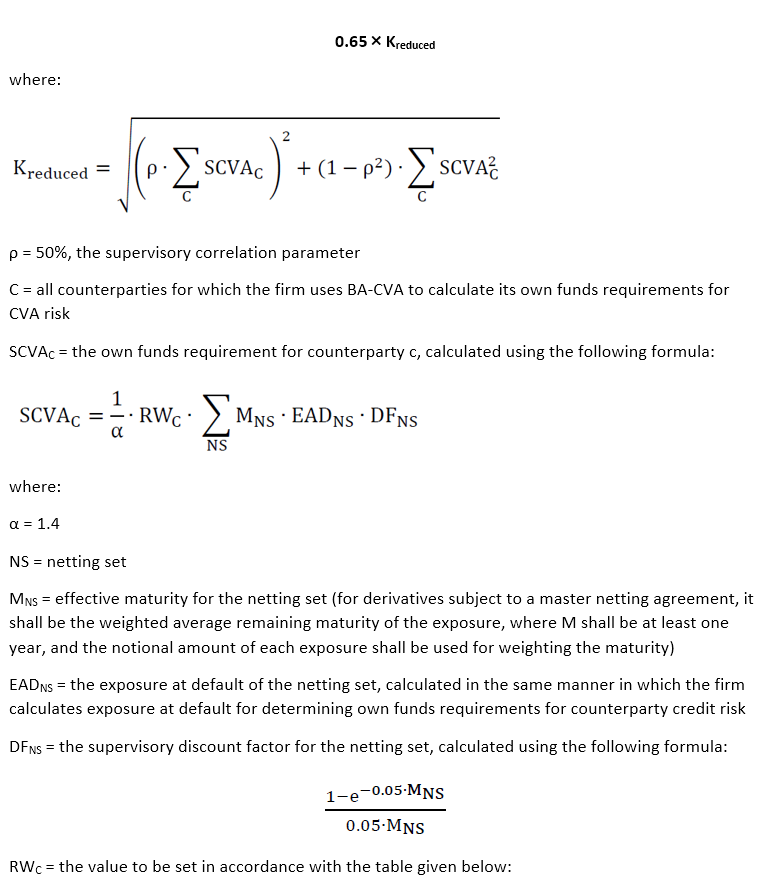
Out of the available methods outlined above, two methods seem appropriate for banks with limited exposure in derivatives, these are the Alternative Approach (AA-CVA) and the reduced version of the Basic Approach (BA-CVAreduced). BA-CVAreduced is relevant for firms that do not hedge CVA risk.
AA-CVA: This approach may be used by a firm with over-the-counter (OTC) derivatives of a notional aggregate amount of less than £88 billion. The firm needs to notify the PRA before using this approach.
In AA-CVA, no separate calculation is required to determine the own funds requirements for CVA risk, it would be equal to the own funds requirements for counterparty credit risk. In other words:
Own funds requirements for CVA risk = Own funds requirements for counterparty credit risk.
BA-CVAreduced: A firm should calculate its own funds requirements for CVA risk under this approach using the following formula:

CVA own funds requirement calculation: an example for AA-CVA and BA-CVAreduced approaches
The following two netting sets and associated counterparty credit risk (CCR) data points are considered as input for this example:

Own funds requirement under AA-CVA:
No separate calculation is required under AA-CVA. The own funds requirement under this approach would be equal to the own funds requirement under CCR i.e. £700.
Own funds requirement under BA-CVAreduced:


